§213.01 Recognized Countries and Regional Patent Offices of Foreign Filing
This page consolidates and annotates all enforceable requirements under MPEP § 213.01, including statutory authority, regulatory rules, examiner guidance, and practice notes. It is provided as guidance, with links to the ground truth sources. This is information only, it is not legal advice.
Recognized Countries and Regional Patent Offices of Foreign Filing
This section addresses Recognized Countries and Regional Patent Offices of Foreign Filing. Primary authority: 35 U.S.C. 119(a), 35 U.S.C. 119(f), and 35 U.S.C. 365(a). Contains: 3 requirements, 1 guidance statement, 4 permissions, and 9 other statements.
Key Rules
Foreign Filing Licenses
The right to rely on a foreign application is known as the right of priority in international patent law and this phrase has been adopted in the U.S. statute. The right of priority originated in a multilateral treaty of 1883, to which the United States adhered in 1887, known as the Paris Convention for the Protection of Industrial Property (Paris Convention). The treaty is administered by the World Intellectual Property Organization (WIPO) at Geneva, Switzerland. This treaty has been revised several times, the latest revision in effect being written in Stockholm in July 1967 (copy at Appendix P of this Manual). Articles 13-30 of the Stockholm Revision became effective on September 5, 1970. Articles 1-12 of the Stockholm Revision became effective on August 25, 1973. One of the many provisions of the Paris Convention requires each of the adhering countries to accord the right of priority to the nationals of the other countries and the first United States statute relating to this subject was enacted to carry out this obligation. A foreign country may also provide for this right by reciprocal legislation.
The right to rely on a foreign application is known as the right of priority in international patent law and this phrase has been adopted in the U.S. statute. The right of priority originated in a multilateral treaty of 1883, to which the United States adhered in 1887, known as the Paris Convention for the Protection of Industrial Property (Paris Convention). The treaty is administered by the World Intellectual Property Organization (WIPO) at Geneva, Switzerland. This treaty has been revised several times, the latest revision in effect being written in Stockholm in July 1967 (copy at Appendix P of this Manual). Articles 13-30 of the Stockholm Revision became effective on September 5, 1970. Articles 1-12 of the Stockholm Revision became effective on August 25, 1973. One of the many provisions of the Paris Convention requires each of the adhering countries to accord the right of priority to the nationals of the other countries and the first United States statute relating to this subject was enacted to carry out this obligation. A foreign country may also provide for this right by reciprocal legislation.
The right to rely on a foreign application is known as the right of priority in international patent law and this phrase has been adopted in the U.S. statute. The right of priority originated in a multilateral treaty of 1883, to which the United States adhered in 1887, known as the Paris Convention for the Protection of Industrial Property (Paris Convention). The treaty is administered by the World Intellectual Property Organization (WIPO) at Geneva, Switzerland. This treaty has been revised several times, the latest revision in effect being written in Stockholm in July 1967 (copy at Appendix P of this Manual). Articles 13-30 of the Stockholm Revision became effective on September 5, 1970. Articles 1-12 of the Stockholm Revision became effective on August 25, 1973. One of the many provisions of the Paris Convention requires each of the adhering countries to accord the right of priority to the nationals of the other countries and the first United States statute relating to this subject was enacted to carry out this obligation. A foreign country may also provide for this right by reciprocal legislation.
The right to rely on a foreign application is known as the right of priority in international patent law and this phrase has been adopted in the U.S. statute. The right of priority originated in a multilateral treaty of 1883, to which the United States adhered in 1887, known as the Paris Convention for the Protection of Industrial Property (Paris Convention). The treaty is administered by the World Intellectual Property Organization (WIPO) at Geneva, Switzerland. This treaty has been revised several times, the latest revision in effect being written in Stockholm in July 1967 (copy at Appendix P of this Manual). Articles 13-30 of the Stockholm Revision became effective on September 5, 1970. Articles 1-12 of the Stockholm Revision became effective on August 25, 1973. One of the many provisions of the Paris Convention requires each of the adhering countries to accord the right of priority to the nationals of the other countries and the first United States statute relating to this subject was enacted to carry out this obligation. A foreign country may also provide for this right by reciprocal legislation.
The right to rely on a foreign application is known as the right of priority in international patent law and this phrase has been adopted in the U.S. statute. The right of priority originated in a multilateral treaty of 1883, to which the United States adhered in 1887, known as the Paris Convention for the Protection of Industrial Property (Paris Convention). The treaty is administered by the World Intellectual Property Organization (WIPO) at Geneva, Switzerland. This treaty has been revised several times, the latest revision in effect being written in Stockholm in July 1967 (copy at Appendix P of this Manual). Articles 13-30 of the Stockholm Revision became effective on September 5, 1970. Articles 1-12 of the Stockholm Revision became effective on August 25, 1973. One of the many provisions of the Paris Convention requires each of the adhering countries to accord the right of priority to the nationals of the other countries and the first United States statute relating to this subject was enacted to carry out this obligation. A foreign country may also provide for this right by reciprocal legislation.
The right to rely on a foreign application is known as the right of priority in international patent law and this phrase has been adopted in the U.S. statute. The right of priority originated in a multilateral treaty of 1883, to which the United States adhered in 1887, known as the Paris Convention for the Protection of Industrial Property (Paris Convention). The treaty is administered by the World Intellectual Property Organization (WIPO) at Geneva, Switzerland. This treaty has been revised several times, the latest revision in effect being written in Stockholm in July 1967 (copy at Appendix P of this Manual). Articles 13-30 of the Stockholm Revision became effective on September 5, 1970. Articles 1-12 of the Stockholm Revision became effective on August 25, 1973. One of the many provisions of the Paris Convention requires each of the adhering countries to accord the right of priority to the nationals of the other countries and the first United States statute relating to this subject was enacted to carry out this obligation. A foreign country may also provide for this right by reciprocal legislation.
The right to rely on a foreign application is known as the right of priority in international patent law and this phrase has been adopted in the U.S. statute. The right of priority originated in a multilateral treaty of 1883, to which the United States adhered in 1887, known as the Paris Convention for the Protection of Industrial Property (Paris Convention). The treaty is administered by the World Intellectual Property Organization (WIPO) at Geneva, Switzerland. This treaty has been revised several times, the latest revision in effect being written in Stockholm in July 1967 (copy at Appendix P of this Manual). Articles 13-30 of the Stockholm Revision became effective on September 5, 1970. Articles 1-12 of the Stockholm Revision became effective on August 25, 1973. One of the many provisions of the Paris Convention requires each of the adhering countries to accord the right of priority to the nationals of the other countries and the first United States statute relating to this subject was enacted to carry out this obligation. A foreign country may also provide for this right by reciprocal legislation.
The right to rely on a foreign application is known as the right of priority in international patent law and this phrase has been adopted in the U.S. statute. The right of priority originated in a multilateral treaty of 1883, to which the United States adhered in 1887, known as the Paris Convention for the Protection of Industrial Property (Paris Convention). The treaty is administered by the World Intellectual Property Organization (WIPO) at Geneva, Switzerland. This treaty has been revised several times, the latest revision in effect being written in Stockholm in July 1967 (copy at Appendix P of this Manual). Articles 13-30 of the Stockholm Revision became effective on September 5, 1970. Articles 1-12 of the Stockholm Revision became effective on August 25, 1973. One of the many provisions of the Paris Convention requires each of the adhering countries to accord the right of priority to the nationals of the other countries and the first United States statute relating to this subject was enacted to carry out this obligation. A foreign country may also provide for this right by reciprocal legislation.
If any applicant asserts the benefit of the filing date of an application filed in a country not on this list, the examiner should contact the Office of Policy and International Affairs to determine if there has been any change in the status of that country. It should be noted that the right is based on the country of the foreign filing and not upon the citizenship of the applicant.
Foreign Priority for International Designs
(a) NATIONAL APPLICATION.—In accordance with the conditions and requirements of subsections (a) through (d) of section 119 and section 172, a national application shall be entitled to the right of priority based on a prior international design application that designated at least 1 country other than the United States.
(a) NATIONAL APPLICATION.—In accordance with the conditions and requirements of subsections (a) through (d) of section 119 and section 172, a national application shall be entitled to the right of priority based on a prior international design application that designated at least 1 country other than the United States.
(b) PRIOR FOREIGN APPLICATION.—In accordance with the conditions and requirements of subsections (a) through (d) of section 119 and section 172 and the treaty and the Regulations, an international design application designating the United States shall be entitled to the right of priority based on a prior foreign application, a prior international application as defined in section 351(c) designating at least 1 country other than the United States, or a prior international design application designating at least 1 country other than the United States.
(b) PRIOR FOREIGN APPLICATION.—In accordance with the conditions and requirements of subsections (a) through (d) of section 119 and section 172 and the treaty and the Regulations, an international design application designating the United States shall be entitled to the right of priority based on a prior foreign application, a prior international application as defined in section 351(c) designating at least 1 country other than the United States, or a prior international design application designating at least 1 country other than the United States.
Pursuant to 35 U.S.C. 386(a) and 37 CFR 1.55, a nonprovisional application may make a claim of foreign priority in accordance with the conditions and requirements of 35 U.S.C. 119(a) – (d) and 172 with respect to a prior international design application that designates at least one country other than the United States. Pursuant to 35 U.S.C. 386(b) and 37 CFR 1.55, an international design application designating the United States may make a claim of foreign priority in accordance with the conditions and requirements of 35 U.S.C. 119(a) – (d) and 172 and the Hague Agreement and Regulations thereunder with respect to a prior foreign application, international application (PCT) designating at least one country other than the United States, or a prior international design application designating at least one country other than the United States. The provisions of 35 U.S.C. 386(a) and (b) apply to nonprovisional applications, international applications (PCT) and international design applications filed on or after May 13, 2015, and patents issued therefrom. See 37 CFR 1.55(o) and MPEP §§ 213 et seq. and 1504.10.
See MPEP § 2920.05(d) for additional information pertaining to the right of priority based upon an international design application.
Right of Priority (Paris Convention)
Following is a table of states, i.e., countries, with respect to which the right of priority referred to in 35 U.S.C. 119(a) – (d) has been recognized. The table indicates whether a basis for priority is that the state is party to the Patent Cooperation Treaty (PCT) or the Paris Convention for the Protection of Industrial Property (Paris), or a member of the World Trade Organization (WTO). See 35 U.S.C. 119(a). See www.wipo.int/pct/en/paris_wto_pct.html for the most current version of the table reproduced below. See also www.wto.org/english/thewto_e/ whatis_e/tif_e/ org6_e.htm for a current list of WTO member countries along with their dates of membership. Applications for plant breeder’s rights filed in WTO member countries and foreign UPOV contracting parties may be relied upon for priority pursuant to 35 U.S.C. 119(f). See MPEP §§ 1612 and 1613.
Following is a table of states, i.e., countries, with respect to which the right of priority referred to in 35 U.S.C. 119(a) – (d) has been recognized. The table indicates whether a basis for priority is that the state is party to the Patent Cooperation Treaty (PCT) or the Paris Convention for the Protection of Industrial Property (Paris), or a member of the World Trade Organization (WTO). See 35 U.S.C. 119(a). See www.wipo.int/pct/en/paris_wto_pct.html for the most current version of the table reproduced below. See also www.wto.org/english/thewto_e/ whatis_e/tif_e/ org6_e.htm for a current list of WTO member countries along with their dates of membership. Applications for plant breeder’s rights filed in WTO member countries and foreign UPOV contracting parties may be relied upon for priority pursuant to 35 U.S.C. 119(f). See MPEP §§ 1612 and 1613.
Following is a table of states, i.e., countries, with respect to which the right of priority referred to in 35 U.S.C. 119(a) – (d) has been recognized. The table indicates whether a basis for priority is that the state is party to the Patent Cooperation Treaty (PCT) or the Paris Convention for the Protection of Industrial Property (Paris), or a member of the World Trade Organization (WTO). See 35 U.S.C. 119(a). See www.wipo.int/pct/en/paris_wto_pct.html for the most current version of the table reproduced below. See also www.wto.org/english/thewto_e/ whatis_e/tif_e/ org6_e.htm for a current list of WTO member countries along with their dates of membership. Applications for plant breeder’s rights filed in WTO member countries and foreign UPOV contracting parties may be relied upon for priority pursuant to 35 U.S.C. 119(f). See MPEP §§ 1612 and 1613.
35 U.S.C. 365(a) provides that a national application shall be entitled to the right of priority based on a prior international application of whatever origin, which designated any country other than, or in addition to, the United States. Of course, the conditions prescribed by 35 U.S.C. 119(a) – (d), which deals with the right of priority based on earlier filed foreign applications, must be complied with.
In addition to the list of recognized countries set forth in subsection I, above, applicants may claim priority under 35 U.S.C. 119(a) – (d) to applications filed in foreign regional patent offices having member states who are members of the Paris Convention. These include the African Regional Intellectual Property Organization (ARIPO), the Eurasian Patent Office (EAPO), the European Patent Office (EPO), the Gulf Cooperation Council (GCC) Patent Office, and the African Intellectual Property Organization (known under the acronym OAPI for its French name, Organisation Africaine de la Propriété Intellectuelle).
Effect of International Filing
(a) In accordance with the conditions and requirements of subsections (a) through (d) of section 119, a national application shall be entitled to the right of priority based on a prior filed international application which designated at least one country other than the United States.
35 U.S.C. 365(a) provides that a national application shall be entitled to the right of priority based on a prior international application of whatever origin, which designated any country other than, or in addition to, the United States. Of course, the conditions prescribed by 35 U.S.C. 119(a) – (d), which deals with the right of priority based on earlier filed foreign applications, must be complied with.
35 U.S.C. 365(b) provides that an international application designating the United States shall be entitled to the right of priority of a prior foreign application which may either be another international application or a regularly filed foreign application. The international application upon which the claim of priority is based can either have been filed in the United States or a foreign country; however, it must contain the designation of at least one country other than, or in addition to, the United States.
Nationals and Residents
(b) In accordance with the conditions and requirements of section 119(a) and the treaty and the Regulations, an international application designating the United States shall be entitled to the right of priority based on a prior foreign application, or a prior international application designating at least one country other than the United States. The Director may establish procedures, including the requirement for payment of the fee specified in section 41(a)(7), to accept an unintentionally delayed claim for priority under the treaty and the Regulations, and to accept a priority claim that pertains to an application that was not filed within the priority period specified in the treaty and Regulations, but was filed within the additional 2-month period specified under section 119(a) or the treaty and Regulations.
35 U.S.C. 365(b) provides that an international application designating the United States shall be entitled to the right of priority of a prior foreign application which may either be another international application or a regularly filed foreign application. The international application upon which the claim of priority is based can either have been filed in the United States or a foreign country; however, it must contain the designation of at least one country other than, or in addition to, the United States.
Design Claim Form
Pursuant to 35 U.S.C. 386(a) and 37 CFR 1.55, a nonprovisional application may make a claim of foreign priority in accordance with the conditions and requirements of 35 U.S.C. 119(a) – (d) and 172 with respect to a prior international design application that designates at least one country other than the United States. Pursuant to 35 U.S.C. 386(b) and 37 CFR 1.55, an international design application designating the United States may make a claim of foreign priority in accordance with the conditions and requirements of 35 U.S.C. 119(a) – (d) and 172 and the Hague Agreement and Regulations thereunder with respect to a prior foreign application, international application (PCT) designating at least one country other than the United States, or a prior international design application designating at least one country other than the United States. The provisions of 35 U.S.C. 386(a) and (b) apply to nonprovisional applications, international applications (PCT) and international design applications filed on or after May 13, 2015, and patents issued therefrom. See 37 CFR 1.55(o) and MPEP §§ 213 et seq. and 1504.10.
Pursuant to 35 U.S.C. 386(a) and 37 CFR 1.55, a nonprovisional application may make a claim of foreign priority in accordance with the conditions and requirements of 35 U.S.C. 119(a) – (d) and 172 with respect to a prior international design application that designates at least one country other than the United States. Pursuant to 35 U.S.C. 386(b) and 37 CFR 1.55, an international design application designating the United States may make a claim of foreign priority in accordance with the conditions and requirements of 35 U.S.C. 119(a) – (d) and 172 and the Hague Agreement and Regulations thereunder with respect to a prior foreign application, international application (PCT) designating at least one country other than the United States, or a prior international design application designating at least one country other than the United States. The provisions of 35 U.S.C. 386(a) and (b) apply to nonprovisional applications, international applications (PCT) and international design applications filed on or after May 13, 2015, and patents issued therefrom. See 37 CFR 1.55(o) and MPEP §§ 213 et seq. and 1504.10.
Hague Definitions
Under Article 4A of the Paris Convention for the Protection of Industrial Property, a right of priority may be based on an application for a patent or for the registration of a utility model or an industrial design filed under the national law of a foreign country adhering to the Convention, or on a foreign application filed under a bilateral or multilateral treaty concluded between two or more such countries. Examples of such treaties pertaining to the protection of designs are The Hague Agreement Concerning the International Registration of Industrial Designs, the Benelux Designs Convention, and the Office for Harmonization in the Internal Market (OHIM) as created under European Union law. Treaties pertaining to utility and/or plant patents include The Convention on the Grant of European Patents (which established the European Patent Office), the Patent Cooperation Treaty, and the International Convention for the Protection of New Varieties of Plants (UPOV).
Under Article 4A of the Paris Convention for the Protection of Industrial Property, a right of priority may be based on an application for a patent or for the registration of a utility model or an industrial design filed under the national law of a foreign country adhering to the Convention, or on a foreign application filed under a bilateral or multilateral treaty concluded between two or more such countries. Examples of such treaties pertaining to the protection of designs are The Hague Agreement Concerning the International Registration of Industrial Designs, the Benelux Designs Convention, and the Office for Harmonization in the Internal Market (OHIM) as created under European Union law. Treaties pertaining to utility and/or plant patents include The Convention on the Grant of European Patents (which established the European Patent Office), the Patent Cooperation Treaty, and the International Convention for the Protection of New Varieties of Plants (UPOV).
Priority and Benefit Claims
Following is a table of states, i.e., countries, with respect to which the right of priority referred to in 35 U.S.C. 119(a) – (d) has been recognized. The table indicates whether a basis for priority is that the state is party to the Patent Cooperation Treaty (PCT) or the Paris Convention for the Protection of Industrial Property (Paris), or a member of the World Trade Organization (WTO). See 35 U.S.C. 119(a). See www.wipo.int/pct/en/paris_wto_pct.html for the most current version of the table reproduced below. See also www.wto.org/english/thewto_e/ whatis_e/tif_e/ org6_e.htm for a current list of WTO member countries along with their dates of membership. Applications for plant breeder’s rights filed in WTO member countries and foreign UPOV contracting parties may be relied upon for priority pursuant to 35 U.S.C. 119(f). See MPEP §§ 1612 and 1613.
Unintentional Delay Standard
(b) In accordance with the conditions and requirements of section 119(a) and the treaty and the Regulations, an international application designating the United States shall be entitled to the right of priority based on a prior foreign application, or a prior international application designating at least one country other than the United States. The Director may establish procedures, including the requirement for payment of the fee specified in section 41(a)(7), to accept an unintentionally delayed claim for priority under the treaty and the Regulations, and to accept a priority claim that pertains to an application that was not filed within the priority period specified in the treaty and Regulations, but was filed within the additional 2-month period specified under section 119(a) or the treaty and Regulations.
International Filing Date
As far as the actual place of filing is concerned, for the purpose of 35 U.S.C. 365(a) and (b) and 35 U.S.C. 119(a) – (d) and (f), an international application designating a country is considered to be a national application regularly filed in that country on the international filing date irrespective of whether it was physically filed in that country, in another country, or in an intergovernmental organization acting as Receiving Office for a country.
Citations
| Primary topic | Citation |
|---|---|
| Design Claim Form Effect of International Filing Foreign Priority for International Designs International Filing Date Priority and Benefit Claims Right of Priority (Paris Convention) | 35 U.S.C. § 119(a) |
| Priority and Benefit Claims Right of Priority (Paris Convention) | 35 U.S.C. § 119(f) |
| Effect of International Filing International Filing Date Right of Priority (Paris Convention) | 35 U.S.C. § 365(a) |
| Effect of International Filing Nationals and Residents | 35 U.S.C. § 365(b) |
| Design Claim Form Foreign Priority for International Designs | 35 U.S.C. § 386(a) |
| Design Claim Form Foreign Priority for International Designs | 35 U.S.C. § 386(b) |
| Design Claim Form Foreign Priority for International Designs | 37 CFR § 1.55 |
| Design Claim Form Foreign Priority for International Designs | 37 CFR § 1.55(o) |
| Priority and Benefit Claims Right of Priority (Paris Convention) | MPEP § 1612 |
| Design Claim Form Foreign Priority for International Designs | MPEP § 213 |
| Foreign Priority for International Designs | MPEP § 2920.05(d) |
Source Text from USPTO’s MPEP
This is an exact copy of the MPEP from the USPTO. It is here for your reference to see the section in context.
Official MPEP § 213.01 — Recognized Countries and Regional Patent Offices of Foreign Filing
Source: USPTO213.01 Recognized Countries and Regional Patent Offices of Foreign Filing [R-10.2019]
The right to rely on a foreign application is known as the right of priority in international patent law and this phrase has been adopted in the U.S. statute. The right of priority originated in a multilateral treaty of 1883, to which the United States adhered in 1887, known as the Paris Convention for the Protection of Industrial Property (Paris Convention). The treaty is administered by the World Intellectual Property Organization (WIPO) at Geneva, Switzerland. This treaty has been revised several times, the latest revision in effect being written in Stockholm in July 1967 (copy at Appendix P of this Manual). Articles 13-30 of the Stockholm Revision became effective on September 5, 1970. Articles 1-12 of the Stockholm Revision became effective on August 25, 1973. One of the many provisions of the Paris Convention requires each of the adhering countries to accord the right of priority to the nationals of the other countries and the first United States statute relating to this subject was enacted to carry out this obligation. A foreign country may also provide for this right by reciprocal legislation.
I. List Of Recognized Countries
Following is a table of states, i.e., countries, with respect to which the right of priority referred to in 35 U.S.C. 119(a)–(d) has been recognized. The table indicates whether a basis for priority is that the state is party to the Patent Cooperation Treaty (PCT) or the Paris Convention for the Protection of Industrial Property (Paris), or a member of the World Trade Organization (WTO). See 35 U.S.C. 119(a). See www.wipo.int/pct/en/paris_wto_pct.html for the most current version of the table reproduced below. See also www.wto.org/english/thewto_e/ whatis_e/tif_e/ org6_e.htm for a current list of WTO member countries along with their dates of membership. Applications for plant breeder’s rights filed in WTO member countries and foreign UPOV contracting parties may be relied upon for priority pursuant to 35 U.S.C. 119(f). See MPEP §§ 1612 and 1613.
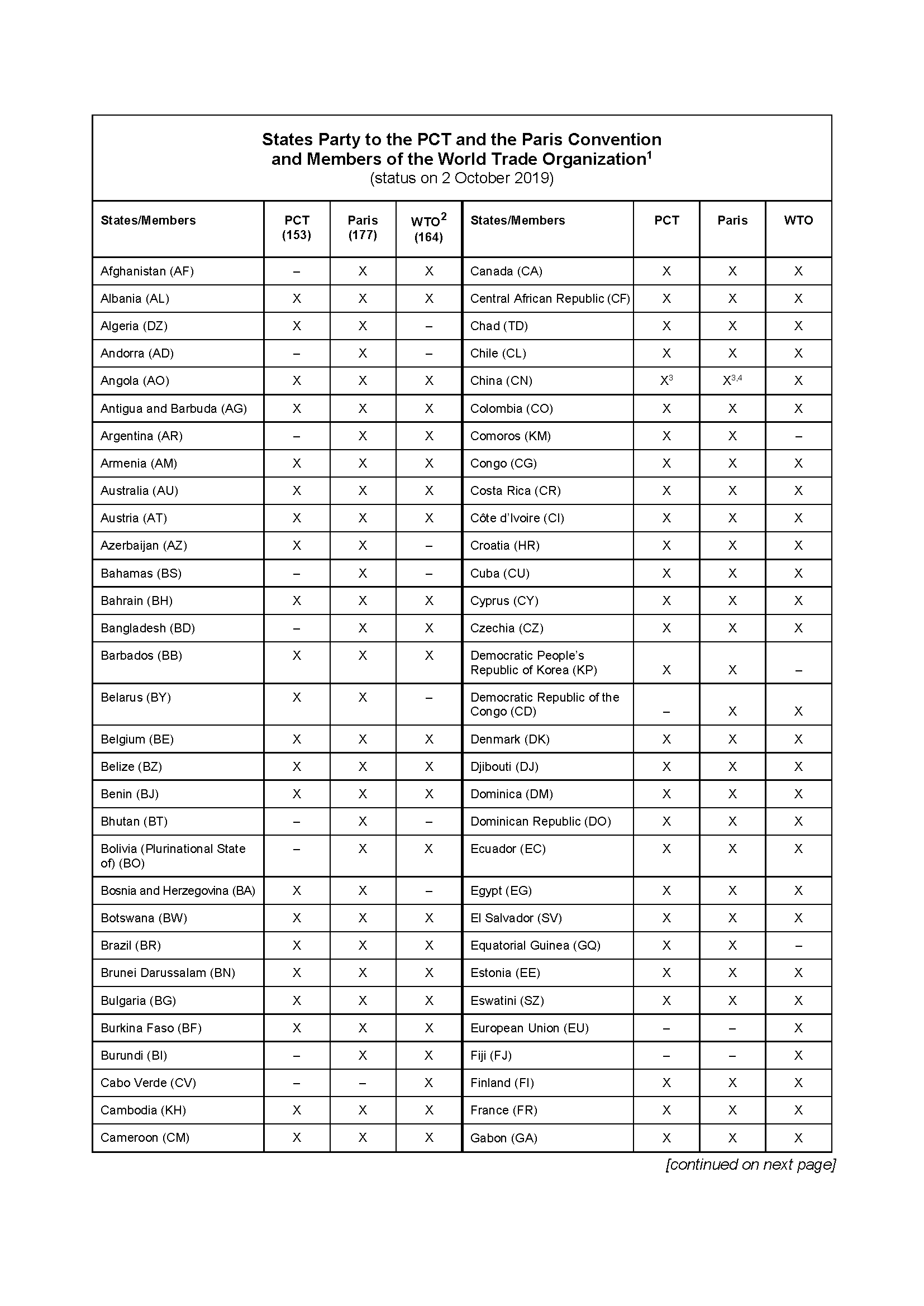
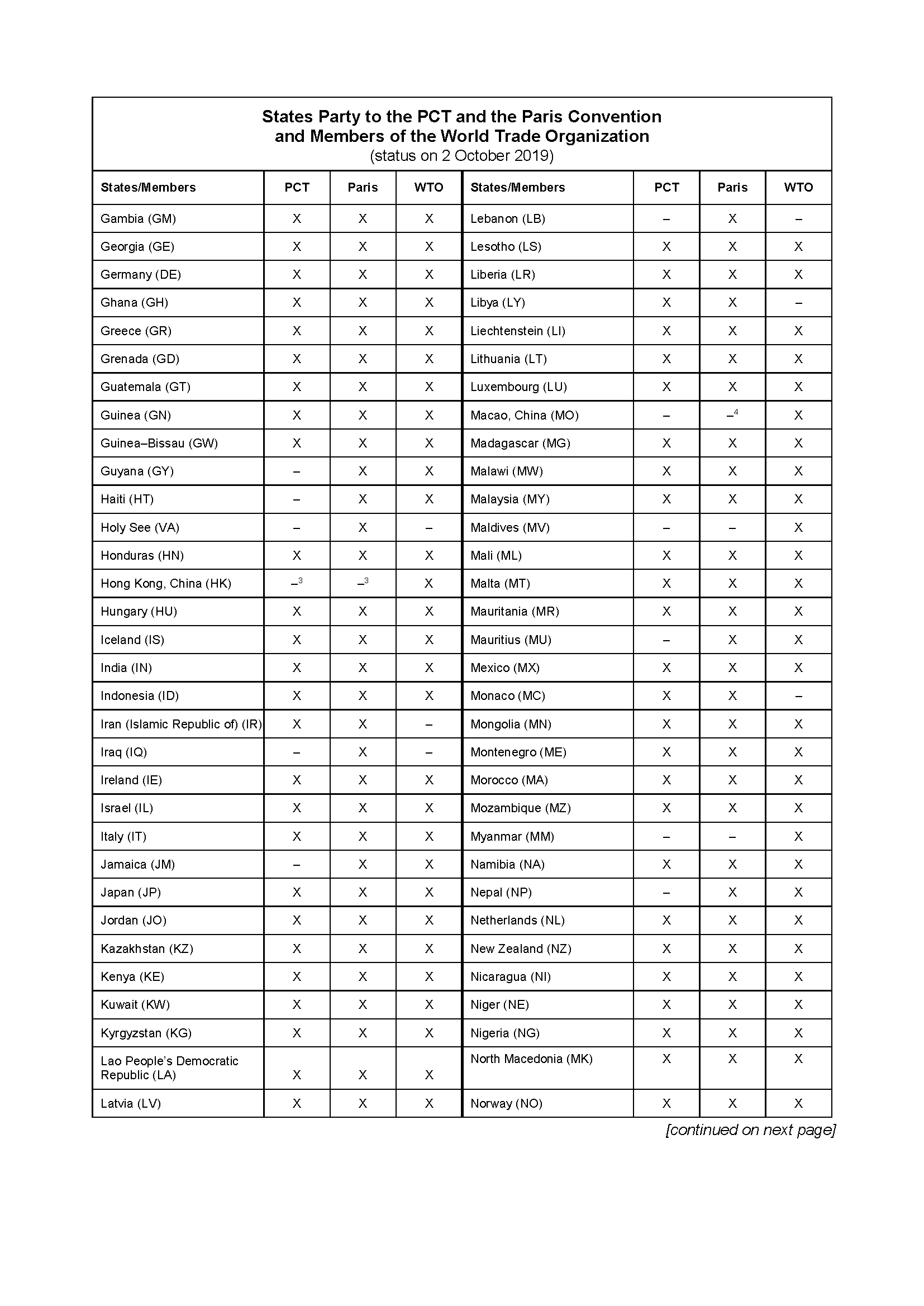
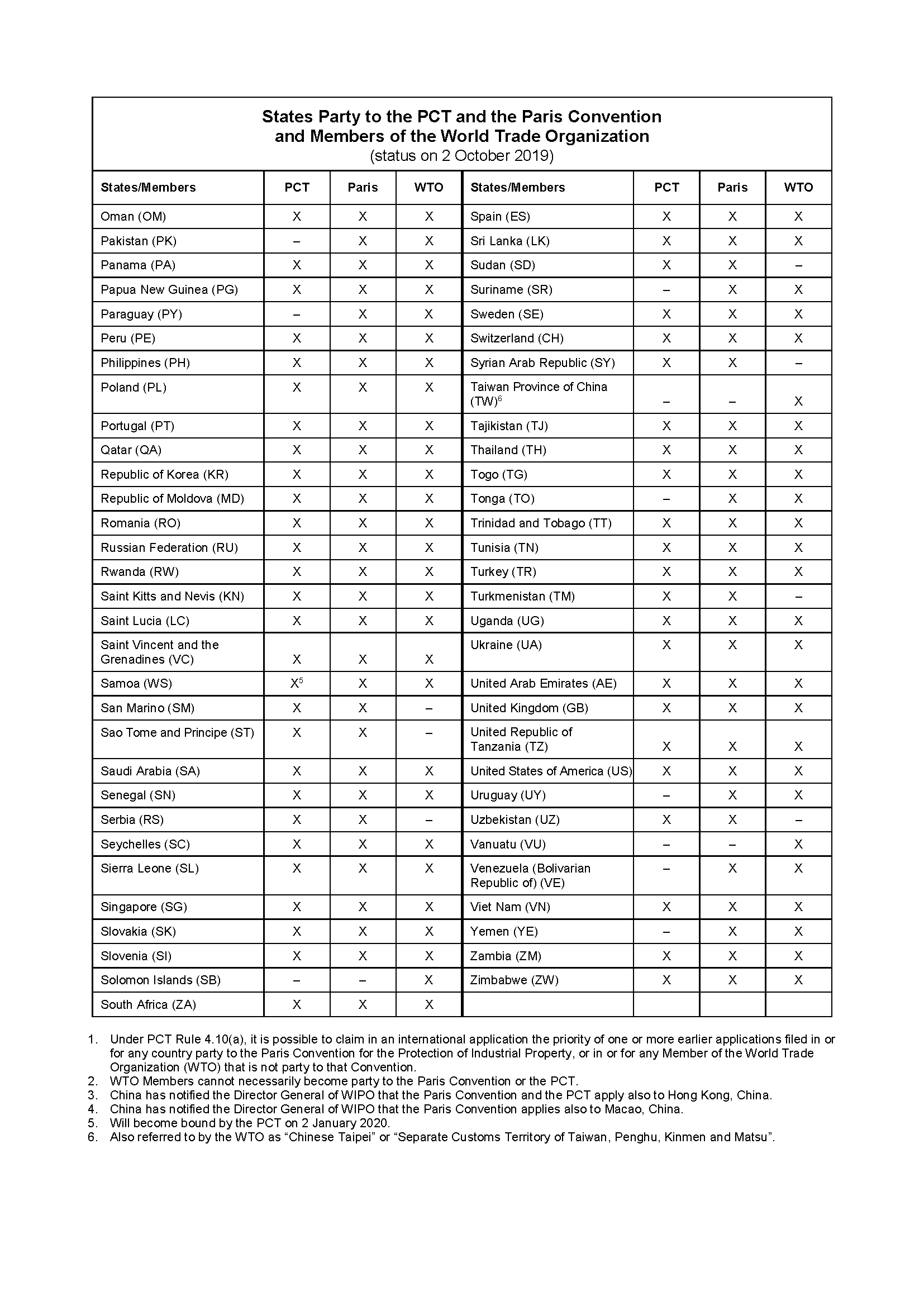
Note that the United States and Taiwan signed an agreement on priority for patent and trademark applications on April 10, 1996, and as of that date Taiwan is a country for which the right of priority is recognized in the United States. Taiwan became a member of the WTO on January 1, 2002.
If any applicant asserts the benefit of the filing date of an application filed in a country not on this list, the examiner should contact the Office of Policy and International Affairs to determine if there has been any change in the status of that country. It should be noted that the right is based on the country of the foreign filing and not upon the citizenship of the applicant.
II. Right Of Priority Based Upon An International Application Filed Under The Patent Cooperation Treaty
35 U.S.C. 365 Right of priority; benefit of the filing date of a prior application.
- (a) In accordance with the conditions and requirements of subsections (a) through (d) of section 119, a national application shall be entitled to the right of priority based on a prior filed international application which designated at least one country other than the United States.
- (b) In accordance with the conditions and requirements of section 119(a) and the treaty and the Regulations, an international application designating the United States shall be entitled to the right of priority based on a prior foreign application, or a prior international application designating at least one country other than the United States. The Director may establish procedures, including the requirement for payment of the fee specified in section 41(a)(7), to accept an unintentionally delayed claim for priority under the treaty and the Regulations, and to accept a priority claim that pertains to an application that was not filed within the priority period specified in the treaty and Regulations, but was filed within the additional 2-month period specified under section 119(a) or the treaty and Regulations.
*****
35 U.S.C. 365(a) provides that a national application shall be entitled to the right of priority based on a prior international application of whatever origin, which designated any country other than, or in addition to, the United States. Of course, the conditions prescribed by 35 U.S.C. 119(a)–(d), which deals with the right of priority based on earlier filed foreign applications, must be complied with.
35 U.S.C. 365(b) provides that an international application designating the United States shall be entitled to the right of priority of a prior foreign application which may either be another international application or a regularly filed foreign application. The international application upon which the claim of priority is based can either have been filed in the United States or a foreign country; however, it must contain the designation of at least one country other than, or in addition to, the United States.
As far as the actual place of filing is concerned, for the purpose of 35 U.S.C. 365(a) and (b) and 35 U.S.C. 119(a)–(d) and (f), an international application designating a country is considered to be a national application regularly filed in that country on the international filing date irrespective of whether it was physically filed in that country, in another country, or in an intergovernmental organization acting as Receiving Office for a country.
III. Right Of Priority Based Upon An International Design Application
35 U.S.C. 386 Right of priority.
- (a) NATIONAL APPLICATION.—In accordance with the conditions and requirements of subsections (a) through (d) of section 119 and section 172, a national application shall be entitled to the right of priority based on a prior international design application that designated at least 1 country other than the United States.
- (b) PRIOR FOREIGN APPLICATION.—In accordance with the conditions and requirements of subsections (a) through (d) of section 119 and section 172 and the treaty and the Regulations, an international design application designating the United States shall be entitled to the right of priority based on a prior foreign application, a prior international application as defined in section 351(c) designating at least 1 country other than the United States, or a prior international design application designating at least 1 country other than the United States.
*****
Pursuant to 35 U.S.C. 386(a) and 37 CFR 1.55, a nonprovisional application may make a claim of foreign priority in accordance with the conditions and requirements of 35 U.S.C. 119(a)–(d) and 172 with respect to a prior international design application that designates at least one country other than the United States. Pursuant to 35 U.S.C. 386(b) and 37 CFR 1.55, an international design application designating the United States may make a claim of foreign priority in accordance with the conditions and requirements of 35 U.S.C. 119(a)–(d) and 172 and the Hague Agreement and Regulations thereunder with respect to a prior foreign application, international application (PCT) designating at least one country other than the United States, or a prior international design application designating at least one country other than the United States. The provisions of 35 U.S.C. 386(a) and (b) apply to nonprovisional applications, international applications (PCT) and international design applications filed on or after May 13, 2015, and patents issued therefrom. See 37 CFR 1.55(o) and MPEP §§ 213et seq. and 1504.10.
See MPEP § 2920.05(d) for additional information pertaining to the right of priority based upon an international design application.
IV. RIGHT OF PRIORITY (35 U.S.C. 119(a)-(d), 365(a)-(b), AND 386(a)-(b)) BASED ON A FOREIGN APPLICATION FILED UNDER A BILATERAL OR MULTILATERAL TREATYUnder Article 4A of the Paris Convention for the Protection of Industrial Property, a right of priority may be based on an application for a patent or for the registration of a utility model or an industrial design filed under the national law of a foreign country adhering to the Convention, or on a foreign application filed under a bilateral or multilateral treaty concluded between two or more such countries. Examples of such treaties pertaining to the protection of designs are The Hague Agreement Concerning the International Registration of Industrial Designs, the Benelux Designs Convention, and the Office for Harmonization in the Internal Market (OHIM) as created under European Union law. Treaties pertaining to utility and/or plant patents include The Convention on the Grant of European Patents (which established the European Patent Office), the Patent Cooperation Treaty, and the International Convention for the Protection of New Varieties of Plants (UPOV).
In addition to the list of recognized countries set forth in subsection I, above, applicants may claim priority under 35 U.S.C. 119(a)–(d) to applications filed in foreign regional patent offices having member states who are members of the Paris Convention. These include the African Regional Intellectual Property Organization (ARIPO), the Eurasian Patent Office (EAPO), the European Patent Office (EPO), the Gulf Cooperation Council (GCC) Patent Office, and the African Intellectual Property Organization (known under the acronym OAPI for its French name, Organisation Africaine de la Propriété Intellectuelle).