§2106 Patent Subject Matter Eligibility
This page consolidates and annotates all enforceable requirements under MPEP § 2106, including statutory authority, regulatory rules, examiner guidance, and practice notes. It is provided as guidance, with links to the ground truth sources. This is information only, it is not legal advice.
Patent Subject Matter Eligibility
This section addresses Patent Subject Matter Eligibility. Primary authority: 35 U.S.C. 101, 35 U.S.C. 100(b), and 35 U.S.C. 112. Contains: 2 requirements, 5 prohibitions, 3 guidance statements, 2 permissions, and 4 other statements.
Pending USPTO Updates
USPTO lists the following post-January 31, 2024 publications as updates not yet incorporated into the current MPEP revision. BlueIron has reviewed the linked USPTO source documents and cross-referenced these updates by affected topic, citation, and identified MPEP target when stated by USPTO. USPTO Subsequent Publications
- 2024 Guidance Update on Patent Subject Matter Eligibility, Including on Artificial Intelligence
- Reminders on evaluating subject matter eligibility of claims under 35 U.S.C. 101
- Subject Matter Eligibility Declarations
- Best Practices for Submission of Rule 132 Subject Matter Eligibility Declarations (SMEDs)
Key Rules
Patent Eligibility
First, the claimed invention must be to one of the four statutory categories. 35 U.S.C. 101 defines the four categories of invention that Congress deemed to be the appropriate subject matter of a patent: processes, machines, manufactures and compositions of matter. The latter three categories define “things” or “products” while the first category defines “actions” (i.e., inventions that consist of a series of steps or acts to be performed). See 35 U.S.C. 100(b) (“The term ‘process’ means process, art, or method, and includes a new use of a known process, machine, manufacture, composition of matter, or material.”). See MPEP § 2106.03 for detailed information on the four categories.
Second, the claimed invention also must qualify as patent-eligible subject matter, i.e., the claim must not be directed to a judicial exception unless the claim as a whole includes additional limitations amounting to significantly more than the exception. The judicial exceptions (also called “judicially recognized exceptions” or simply “exceptions”) are subject matter that the courts have found to be outside of, or exceptions to, the four statutory categories of invention, and are limited to abstract ideas, laws of nature and natural phenomena (including products of nature). Alice Corp. Pty. Ltd. v. CLS Bank Int'l, 573 U.S. 208, 216, 110 USPQ2d 1976, 1980 (2014) (citing Ass'n for Molecular Pathology v. Myriad Genetics, Inc., 569 U.S. 576, 589, 106 USPQ2d 1972, 1979 (2013). See MPEP § 2106.04 for detailed information on the judicial exceptions.
Because abstract ideas, laws of nature, and natural phenomenon "are the basic tools of scientific and technological work", the Supreme Court has expressed concern that monopolizing these tools by granting patent rights may impede innovation rather than promote it. See Alice Corp., 573 U.S. at 216, 110 USPQ2d at 1980; Mayo Collaborative Servs. v. Prometheus Labs., Inc., 566 U.S. 66, 71, 101 USPQ2d 1961, 1965 (2012). However, the Court has also emphasized that an invention is not considered to be ineligible for patenting simply because it involves a judicial exception. Alice Corp., 573 U.S. at 217, 110 USPQ2d at 1980-81 (citing Diamond v. Diehr, 450 U.S. 175, 187, 209 USPQ 1, 8 (1981)). See also Thales Visionix Inc. v. United States, 850 F.3d. 1343, 1349, 121 USPQ2d 1898, 1902 (Fed. Cir. 2017) (“That a mathematical equation is required to complete the claimed method and system does not doom the claims to abstraction.”). Accordingly, the Court has said that integration of an abstract idea, law of nature or natural phenomenon into a practical application may be eligible for patent protection. See, e.g., Alice, 573 U.S. at 217, 110 USPQ2d at 1981 (explaining that “in applying the §101 exception, we must distinguish between patents that claim the ‘buildin[g] block[s]’ of human ingenuity and those that integrate the building blocks into something more” (quoting Mayo, 566 U.S. at 89, 110 USPQ2d at 1971) and stating that Mayo “set forth a framework for distinguishing patents that claim laws of nature, natural phenomena, and abstract ideas from those that claim patent-eligible applications of those concepts”); Mayo, 566 U.S. at 80, 84, 101 USPQ2d at 1969, 1971 (noting that the Court in Diamond v. Diehr found “the overall process patent eligible because of the way the additional steps of the process integrated the equation into the process as a whole,” but the Court in Gottschalk v. Benson “held that simply implementing a mathematical principle on a physical machine, namely a computer, was not a patentable application of that principle”); Bilski v. Kappos, 561 U.S. 593, 611, 95 USPQ2d 1001, 1010 (2010) (“ Diehr explained that while an abstract idea, law of nature, or mathematical formula could not be patented, ‘an application of a law of nature or mathematical formula to a known structure or process may well be deserving of patent protection.’” (quoting Diamond v. Diehr, 450 U.S. 175, 187, 209 USPQ 1, 8 (1981)) (emphasis in original)); Diehr, 450 U.S. at 187, 192 n.14, 209 USPQ at 10 n.14 (explaining that the process in Parker v. Flook was ineligible not because it contained a mathematical formula, but because it did not provide an application of the formula). See Diamond v. Diehr, 450 U.S. 175, 209 USPQ 1 (1981); Gottschalk v. Benson, 409 U.S. 63, 175 USPQ 673 (1972); Parker v. Flook, 437 U.S. 584, 198 USPQ 193 (1978).
Because abstract ideas, laws of nature, and natural phenomenon "are the basic tools of scientific and technological work", the Supreme Court has expressed concern that monopolizing these tools by granting patent rights may impede innovation rather than promote it. See Alice Corp., 573 U.S. at 216, 110 USPQ2d at 1980; Mayo Collaborative Servs. v. Prometheus Labs., Inc., 566 U.S. 66, 71, 101 USPQ2d 1961, 1965 (2012). However, the Court has also emphasized that an invention is not considered to be ineligible for patenting simply because it involves a judicial exception. Alice Corp., 573 U.S. at 217, 110 USPQ2d at 1980-81 (citing Diamond v. Diehr, 450 U.S. 175, 187, 209 USPQ 1, 8 (1981)). See also Thales Visionix Inc. v. United States, 850 F.3d. 1343, 1349, 121 USPQ2d 1898, 1902 (Fed. Cir. 2017) (“That a mathematical equation is required to complete the claimed method and system does not doom the claims to abstraction.”). Accordingly, the Court has said that integration of an abstract idea, law of nature or natural phenomenon into a practical application may be eligible for patent protection. See, e.g., Alice, 573 U.S. at 217, 110 USPQ2d at 1981 (explaining that “in applying the §101 exception, we must distinguish between patents that claim the ‘buildin[g] block[s]’ of human ingenuity and those that integrate the building blocks into something more” (quoting Mayo, 566 U.S. at 89, 110 USPQ2d at 1971) and stating that Mayo “set forth a framework for distinguishing patents that claim laws of nature, natural phenomena, and abstract ideas from those that claim patent-eligible applications of those concepts”); Mayo, 566 U.S. at 80, 84, 101 USPQ2d at 1969, 1971 (noting that the Court in Diamond v. Diehr found “the overall process patent eligible because of the way the additional steps of the process integrated the equation into the process as a whole,” but the Court in Gottschalk v. Benson “held that simply implementing a mathematical principle on a physical machine, namely a computer, was not a patentable application of that principle”); Bilski v. Kappos, 561 U.S. 593, 611, 95 USPQ2d 1001, 1010 (2010) (“ Diehr explained that while an abstract idea, law of nature, or mathematical formula could not be patented, ‘an application of a law of nature or mathematical formula to a known structure or process may well be deserving of patent protection.’” (quoting Diamond v. Diehr, 450 U.S. 175, 187, 209 USPQ 1, 8 (1981)) (emphasis in original)); Diehr, 450 U.S. at 187, 192 n.14, 209 USPQ at 10 n.14 (explaining that the process in Parker v. Flook was ineligible not because it contained a mathematical formula, but because it did not provide an application of the formula). See Diamond v. Diehr, 450 U.S. 175, 209 USPQ 1 (1981); Gottschalk v. Benson, 409 U.S. 63, 175 USPQ 673 (1972); Parker v. Flook, 437 U.S. 584, 198 USPQ 193 (1978).
Because abstract ideas, laws of nature, and natural phenomenon "are the basic tools of scientific and technological work", the Supreme Court has expressed concern that monopolizing these tools by granting patent rights may impede innovation rather than promote it. See Alice Corp., 573 U.S. at 216, 110 USPQ2d at 1980; Mayo Collaborative Servs. v. Prometheus Labs., Inc., 566 U.S. 66, 71, 101 USPQ2d 1961, 1965 (2012). However, the Court has also emphasized that an invention is not considered to be ineligible for patenting simply because it involves a judicial exception. Alice Corp., 573 U.S. at 217, 110 USPQ2d at 1980-81 (citing Diamond v. Diehr, 450 U.S. 175, 187, 209 USPQ 1, 8 (1981)). See also Thales Visionix Inc. v. United States, 850 F.3d. 1343, 1349, 121 USPQ2d 1898, 1902 (Fed. Cir. 2017) (“That a mathematical equation is required to complete the claimed method and system does not doom the claims to abstraction.”). Accordingly, the Court has said that integration of an abstract idea, law of nature or natural phenomenon into a practical application may be eligible for patent protection. See, e.g., Alice, 573 U.S. at 217, 110 USPQ2d at 1981 (explaining that “in applying the §101 exception, we must distinguish between patents that claim the ‘buildin[g] block[s]’ of human ingenuity and those that integrate the building blocks into something more” (quoting Mayo, 566 U.S. at 89, 110 USPQ2d at 1971) and stating that Mayo “set forth a framework for distinguishing patents that claim laws of nature, natural phenomena, and abstract ideas from those that claim patent-eligible applications of those concepts”); Mayo, 566 U.S. at 80, 84, 101 USPQ2d at 1969, 1971 (noting that the Court in Diamond v. Diehr found “the overall process patent eligible because of the way the additional steps of the process integrated the equation into the process as a whole,” but the Court in Gottschalk v. Benson “held that simply implementing a mathematical principle on a physical machine, namely a computer, was not a patentable application of that principle”); Bilski v. Kappos, 561 U.S. 593, 611, 95 USPQ2d 1001, 1010 (2010) (“ Diehr explained that while an abstract idea, law of nature, or mathematical formula could not be patented, ‘an application of a law of nature or mathematical formula to a known structure or process may well be deserving of patent protection.’” (quoting Diamond v. Diehr, 450 U.S. 175, 187, 209 USPQ 1, 8 (1981)) (emphasis in original)); Diehr, 450 U.S. at 187, 192 n.14, 209 USPQ at 10 n.14 (explaining that the process in Parker v. Flook was ineligible not because it contained a mathematical formula, but because it did not provide an application of the formula). See Diamond v. Diehr, 450 U.S. 175, 209 USPQ 1 (1981); Gottschalk v. Benson, 409 U.S. 63, 175 USPQ 673 (1972); Parker v. Flook, 437 U.S. 584, 198 USPQ 193 (1978).
The Alice/Mayo two-part test is the only test that should be used to evaluate the eligibility of claims under examination. While the machine-or-transformation test is an important clue to eligibility, it should not be used as a separate test for eligibility. Instead it should be considered as part of the "integration" determination or "significantly more" determination articulated in the Alice/Mayo test. Bilski v. Kappos, 561 U.S. 593, 605, 95 USPQ2d 1001, 1007 (2010). See MPEP § 2106.04(d) for more information about evaluating whether a claim reciting a judicial exception is integrated into a practical application and MPEP § 2106.05(b) and MPEP § 2106.05(c) for more information about how the machine-or-transformation test fits into the Alice/Mayo two-part framework. Likewise, eligibility should not be evaluated based on whether the claim recites a "useful, concrete, and tangible result," State Street Bank, 149 F.3d 1368, 1374, 47 USPQ2d 1596, 1602 (Fed. Cir. 1998) (quoting In re Alappat, 33 F.3d 1526, 1544, 31 USPQ2d 1545, 1557 (Fed. Cir. 1994)), as this test has been superseded. In re Bilski, 545 F.3d 943, 959-60, 88 USPQ2d 1385, 1394-95 (Fed. Cir. 2008) (en banc), aff'd by Bilski v. Kappos, 561 U.S. 593, 95 USPQ2d 1001 (2010). See also TLI Communications LLC v. AV Automotive LLC, 823 F.3d 607, 613, 118 USPQ2d 1744, 1748 (Fed. Cir. 2016) (“It is well-settled that mere recitation of concrete, tangible components is insufficient to confer patent eligibility to an otherwise abstract idea”). The programmed computer or “special purpose computer” test of In re Alappat, 33 F.3d 1526, 31 USPQ2d 1545 (Fed. Cir. 1994) (i.e., the rationale that an otherwise ineligible algorithm or software could be made patent-eligible by merely adding a generic computer to the claim for the “special purpose” of executing the algorithm or software) was also superseded by the Supreme Court’s Bilski and Alice Corp. decisions. Eon Corp. IP Holdings LLC v. AT&T Mobility LLC, 785 F.3d 616, 623, 114 USPQ2d 1711, 1715 (Fed. Cir. 2015) (“[W]e note that Alappat has been superseded by Bilski, 561 U.S. at 605–06, and Alice Corp. v. CLS Bank Int’l, 573 U.S. 208, 110 USPQ2d 1976 (2014)”); Intellectual Ventures I LLC v. Capital One Bank (USA), N.A., 792 F.3d 1363, 1366, 115 USPQ2d 1636, 1639 (Fed. Cir. 2015) (“An abstract idea does not become nonabstract by limiting the invention to a particular field of use or technological environment, such as the Internet [or] a computer”). Lastly, eligibility should not be evaluated based on whether the claimed invention has utility, because “[u]tility is not the test for patent-eligible subject matter.” Genetic Techs. Ltd. v. Merial LLC, 818 F.3d 1369, 1380, 118 USPQ2d 1541, 1548 (Fed. Cir. 2016).
The Alice/Mayo two-part test is the only test that should be used to evaluate the eligibility of claims under examination. While the machine-or-transformation test is an important clue to eligibility, it should not be used as a separate test for eligibility. Instead it should be considered as part of the "integration" determination or "significantly more" determination articulated in the Alice/Mayo test. Bilski v. Kappos, 561 U.S. 593, 605, 95 USPQ2d 1001, 1007 (2010). See MPEP § 2106.04(d) for more information about evaluating whether a claim reciting a judicial exception is integrated into a practical application and MPEP § 2106.05(b) and MPEP § 2106.05(c) for more information about how the machine-or-transformation test fits into the Alice/Mayo two-part framework. Likewise, eligibility should not be evaluated based on whether the claim recites a "useful, concrete, and tangible result," State Street Bank, 149 F.3d 1368, 1374, 47 USPQ2d 1596, 1602 (Fed. Cir. 1998) (quoting In re Alappat, 33 F.3d 1526, 1544, 31 USPQ2d 1545, 1557 (Fed. Cir. 1994)), as this test has been superseded. In re Bilski, 545 F.3d 943, 959-60, 88 USPQ2d 1385, 1394-95 (Fed. Cir. 2008) (en banc), aff'd by Bilski v. Kappos, 561 U.S. 593, 95 USPQ2d 1001 (2010). See also TLI Communications LLC v. AV Automotive LLC, 823 F.3d 607, 613, 118 USPQ2d 1744, 1748 (Fed. Cir. 2016) (“It is well-settled that mere recitation of concrete, tangible components is insufficient to confer patent eligibility to an otherwise abstract idea”). The programmed computer or “special purpose computer” test of In re Alappat, 33 F.3d 1526, 31 USPQ2d 1545 (Fed. Cir. 1994) (i.e., the rationale that an otherwise ineligible algorithm or software could be made patent-eligible by merely adding a generic computer to the claim for the “special purpose” of executing the algorithm or software) was also superseded by the Supreme Court’s Bilski and Alice Corp. decisions. Eon Corp. IP Holdings LLC v. AT&T Mobility LLC, 785 F.3d 616, 623, 114 USPQ2d 1711, 1715 (Fed. Cir. 2015) (“[W]e note that Alappat has been superseded by Bilski, 561 U.S. at 605–06, and Alice Corp. v. CLS Bank Int’l, 573 U.S. 208, 110 USPQ2d 1976 (2014)”); Intellectual Ventures I LLC v. Capital One Bank (USA), N.A., 792 F.3d 1363, 1366, 115 USPQ2d 1636, 1639 (Fed. Cir. 2015) (“An abstract idea does not become nonabstract by limiting the invention to a particular field of use or technological environment, such as the Internet [or] a computer”). Lastly, eligibility should not be evaluated based on whether the claimed invention has utility, because “[u]tility is not the test for patent-eligible subject matter.” Genetic Techs. Ltd. v. Merial LLC, 818 F.3d 1369, 1380, 118 USPQ2d 1541, 1548 (Fed. Cir. 2016).
Examiners are reminded that 35 U.S.C. 101 is not the sole tool for determining patentability; 35 U.S.C. 112, 35 U.S.C. 102, and 35 U.S.C. 103 will provide additional tools for ensuring that the claim meets the conditions for patentability. As the Supreme Court made clear in Bilski, 561 U.S. at 602, 95 USPQ2d at 1006:
Examiners are reminded that 35 U.S.C. 101 is not the sole tool for determining patentability; 35 U.S.C. 112, 35 U.S.C. 102, and 35 U.S.C. 103 will provide additional tools for ensuring that the claim meets the conditions for patentability. As the Supreme Court made clear in Bilski, 561 U.S. at 602, 95 USPQ2d at 1006:
The § 101 patent-eligibility inquiry is only a threshold test. Even if an invention qualifies as a process, machine, manufacture, or composition of matter, in order to receive the Patent Act’s protection the claimed invention must also satisfy ‘‘the conditions and requirements of this title.’’ § 101. Those requirements include that the invention be novel, see § 102, nonobvious, see § 103, and fully and particularly described, see § 112.
The § 101 patent-eligibility inquiry is only a threshold test. Even if an invention qualifies as a process, machine, manufacture, or composition of matter, in order to receive the Patent Act’s protection the claimed invention must also satisfy ‘‘the conditions and requirements of this title.’’ § 101. Those requirements include that the invention be novel, see § 102, nonobvious, see § 103, and fully and particularly described, see § 112.
The § 101 patent-eligibility inquiry is only a threshold test. Even if an invention qualifies as a process, machine, manufacture, or composition of matter, in order to receive the Patent Act’s protection the claimed invention must also satisfy ‘‘the conditions and requirements of this title.’’ § 101. Those requirements include that the invention be novel, see § 102, nonobvious, see § 103, and fully and particularly described, see § 112.
It is essential that the broadest reasonable interpretation (BRI) of the claim be established prior to examining a claim for eligibility. The BRI sets the boundaries of the coverage sought by the claim and will influence whether the claim seeks to cover subject matter that is beyond the four statutory categories or encompasses subject matter that falls within the exceptions. See MyMail, Ltd. v. ooVoo, LLC, 934 F.3d 1373, 1379, 2019 USPQ2d 305789 (Fed. Cir. 2019) (“Determining patent eligibility requires a full understanding of the basic character of the claimed subject matter”), citing Bancorp Servs., LLC v. Sun Life Assurance Co. of Can. (U.S.), 687 F.3d 1266, 1273-74, 103 USPQ2d 1425, 1430 (Fed. Cir. 2012); In re Bilski, 545 F.3d 943, 951, 88 USPQ2d 1385, 1388 (Fed. Cir. 2008) (en banc), aff'd by Bilski v. Kappos, 561 U.S. 593, 95 USPQ2d 1001 (2010) (“claim construction … is an important first step in a § 101 analysis”). Evaluating eligibility based on the BRI also ensures that patent eligibility under 35 U.S.C. 101 does not depend simply on the draftsman’s art. Alice, 573 U.S. 208, 224, 110 USPQ2d at 1984, 1985 (citing Parker v. Flook, 437 U.S. 584, 593, 198 USPQ 193, 198 (1978) and Mayo, 566 U.S. at 72, 101 USPQ2d at 1966). See MPEP § 2111 for more information about determining the BRI.
It is essential that the broadest reasonable interpretation (BRI) of the claim be established prior to examining a claim for eligibility. The BRI sets the boundaries of the coverage sought by the claim and will influence whether the claim seeks to cover subject matter that is beyond the four statutory categories or encompasses subject matter that falls within the exceptions. See MyMail, Ltd. v. ooVoo, LLC, 934 F.3d 1373, 1379, 2019 USPQ2d 305789 (Fed. Cir. 2019) (“Determining patent eligibility requires a full understanding of the basic character of the claimed subject matter”), citing Bancorp Servs., LLC v. Sun Life Assurance Co. of Can. (U.S.), 687 F.3d 1266, 1273-74, 103 USPQ2d 1425, 1430 (Fed. Cir. 2012); In re Bilski, 545 F.3d 943, 951, 88 USPQ2d 1385, 1388 (Fed. Cir. 2008) (en banc), aff'd by Bilski v. Kappos, 561 U.S. 593, 95 USPQ2d 1001 (2010) (“claim construction … is an important first step in a § 101 analysis”). Evaluating eligibility based on the BRI also ensures that patent eligibility under 35 U.S.C. 101 does not depend simply on the draftsman’s art. Alice, 573 U.S. 208, 224, 110 USPQ2d at 1984, 1985 (citing Parker v. Flook, 437 U.S. 584, 593, 198 USPQ 193, 198 (1978) and Mayo, 566 U.S. at 72, 101 USPQ2d at 1966). See MPEP § 2111 for more information about determining the BRI.
It is essential that the broadest reasonable interpretation (BRI) of the claim be established prior to examining a claim for eligibility. The BRI sets the boundaries of the coverage sought by the claim and will influence whether the claim seeks to cover subject matter that is beyond the four statutory categories or encompasses subject matter that falls within the exceptions. See MyMail, Ltd. v. ooVoo, LLC, 934 F.3d 1373, 1379, 2019 USPQ2d 305789 (Fed. Cir. 2019) (“Determining patent eligibility requires a full understanding of the basic character of the claimed subject matter”), citing Bancorp Servs., LLC v. Sun Life Assurance Co. of Can. (U.S.), 687 F.3d 1266, 1273-74, 103 USPQ2d 1425, 1430 (Fed. Cir. 2012); In re Bilski, 545 F.3d 943, 951, 88 USPQ2d 1385, 1388 (Fed. Cir. 2008) (en banc), aff'd by Bilski v. Kappos, 561 U.S. 593, 95 USPQ2d 1001 (2010) (“claim construction … is an important first step in a § 101 analysis”). Evaluating eligibility based on the BRI also ensures that patent eligibility under 35 U.S.C. 101 does not depend simply on the draftsman’s art. Alice, 573 U.S. 208, 224, 110 USPQ2d at 1984, 1985 (citing Parker v. Flook, 437 U.S. 584, 593, 198 USPQ 193, 198 (1978) and Mayo, 566 U.S. at 72, 101 USPQ2d at 1966). See MPEP § 2111 for more information about determining the BRI.
It is essential that the broadest reasonable interpretation (BRI) of the claim be established prior to examining a claim for eligibility. The BRI sets the boundaries of the coverage sought by the claim and will influence whether the claim seeks to cover subject matter that is beyond the four statutory categories or encompasses subject matter that falls within the exceptions. See MyMail, Ltd. v. ooVoo, LLC, 934 F.3d 1373, 1379, 2019 USPQ2d 305789 (Fed. Cir. 2019) (“Determining patent eligibility requires a full understanding of the basic character of the claimed subject matter”), citing Bancorp Servs., LLC v. Sun Life Assurance Co. of Can. (U.S.), 687 F.3d 1266, 1273-74, 103 USPQ2d 1425, 1430 (Fed. Cir. 2012); In re Bilski, 545 F.3d 943, 951, 88 USPQ2d 1385, 1388 (Fed. Cir. 2008) (en banc), aff'd by Bilski v. Kappos, 561 U.S. 593, 95 USPQ2d 1001 (2010) (“claim construction … is an important first step in a § 101 analysis”). Evaluating eligibility based on the BRI also ensures that patent eligibility under 35 U.S.C. 101 does not depend simply on the draftsman’s art. Alice, 573 U.S. 208, 224, 110 USPQ2d at 1984, 1985 (citing Parker v. Flook, 437 U.S. 584, 593, 198 USPQ 193, 198 (1978) and Mayo, 566 U.S. at 72, 101 USPQ2d at 1966). See MPEP § 2111 for more information about determining the BRI.
It is essential that the broadest reasonable interpretation (BRI) of the claim be established prior to examining a claim for eligibility. The BRI sets the boundaries of the coverage sought by the claim and will influence whether the claim seeks to cover subject matter that is beyond the four statutory categories or encompasses subject matter that falls within the exceptions. See MyMail, Ltd. v. ooVoo, LLC, 934 F.3d 1373, 1379, 2019 USPQ2d 305789 (Fed. Cir. 2019) (“Determining patent eligibility requires a full understanding of the basic character of the claimed subject matter”), citing Bancorp Servs., LLC v. Sun Life Assurance Co. of Can. (U.S.), 687 F.3d 1266, 1273-74, 103 USPQ2d 1425, 1430 (Fed. Cir. 2012); In re Bilski, 545 F.3d 943, 951, 88 USPQ2d 1385, 1388 (Fed. Cir. 2008) (en banc), aff'd by Bilski v. Kappos, 561 U.S. 593, 95 USPQ2d 1001 (2010) (“claim construction … is an important first step in a § 101 analysis”). Evaluating eligibility based on the BRI also ensures that patent eligibility under 35 U.S.C. 101 does not depend simply on the draftsman’s art. Alice, 573 U.S. 208, 224, 110 USPQ2d at 1984, 1985 (citing Parker v. Flook, 437 U.S. 584, 593, 198 USPQ 193, 198 (1978) and Mayo, 566 U.S. at 72, 101 USPQ2d at 1966). See MPEP § 2111 for more information about determining the BRI.
Claim interpretation affects the evaluation of both criteria for eligibility. For example, in Mentor Graphics v. EVE-USA, Inc., 851 F.3d 1275, 112 USPQ2d 1120 (Fed. Cir. 2017), claim interpretation was crucial to the court’s determination that claims to a “machine-readable medium” were not to a statutory category. In Mentor Graphics, the court interpreted the claims in light of the specification, which expressly defined the medium as encompassing “any data storage device” including random-access memory and carrier waves. Although random-access memory and magnetic tape are statutory media, carrier waves are not because they are signals similar to the transitory, propagating signals held to be non-statutory in Nuijten. 851 F.3d at 1294, 112 USPQ2d at 1133 (citing In re Nuijten, 500 F.3d 1346, 84 USPQ2d 1495 (Fed. Cir. 2007)). Accordingly, because the BRI of the claims covered both subject matter that falls within a statutory category (the random-access memory), as well as subject matter that does not (the carrier waves), the claims as a whole were not to a statutory category and thus failed the first criterion for eligibility.
Claim interpretation affects the evaluation of both criteria for eligibility. For example, in Mentor Graphics v. EVE-USA, Inc., 851 F.3d 1275, 112 USPQ2d 1120 (Fed. Cir. 2017), claim interpretation was crucial to the court’s determination that claims to a “machine-readable medium” were not to a statutory category. In Mentor Graphics, the court interpreted the claims in light of the specification, which expressly defined the medium as encompassing “any data storage device” including random-access memory and carrier waves. Although random-access memory and magnetic tape are statutory media, carrier waves are not because they are signals similar to the transitory, propagating signals held to be non-statutory in Nuijten. 851 F.3d at 1294, 112 USPQ2d at 1133 (citing In re Nuijten, 500 F.3d 1346, 84 USPQ2d 1495 (Fed. Cir. 2007)). Accordingly, because the BRI of the claims covered both subject matter that falls within a statutory category (the random-access memory), as well as subject matter that does not (the carrier waves), the claims as a whole were not to a statutory category and thus failed the first criterion for eligibility.
With regard to the second criterion for eligibility, the Alice/Mayo test, claim interpretation can affect the first part of the test (whether the claims are directed to a judicial exception). For example, the patentee in Synopsys argued that the claimed methods of logic circuit design were intended to be used in conjunction with computer-based design tools, and were thus not mental processes. Synopsys, Inc. v. Mentor Graphics Corp., 839 F.3d 1138, 1147-49, 120 USPQ2d 1473, 1480-81 (Fed. Cir. 2016). The court disagreed, because it interpreted the claims as encompassing nothing other than pure mental steps (and thus falling within an abstract idea grouping) because the claims did not include any limitations requiring computer implementation. In contrast, the patentee in Enfish argued that its claimed self-referential table for a computer database was an improvement in an existing technology and thus not directed to an abstract idea. Enfish, LLC v. Microsoft Corp., 822 F.3d 1327, 1336-37, 118 USPQ2d 1684, 1689-90 (Fed. Cir. 2016). The court agreed with the patentee, based on its interpretation of the claimed “means for configuring” under 35 U.S.C. 112(f) as requiring a four-step algorithm that achieved the improvements, as opposed to merely any form of storing tabular data. See also McRO, Inc. v. Bandai Namco Games America, Inc. 837 F.3d 1299, 1314, 120 USPQ2d 1091, 1102 (Fed. Cir. 2016) (the claim’s construction incorporated rules of a particular type that improved an existing technological process). Claim interpretation can also affect the second part of the Alice/Mayo test (whether the claim recites additional elements that amount to significantly more than the judicial exception). For example, in Amdocs (Israel) Ltd. v. Openet Telecom, Inc., where the court relied on the construction of the term “enhance” (to require application of a number of field enhancements in a distributed fashion) to determine that the claim entails an unconventional technical solution to a technological problem. 841 F.3d 1288, 1300-01, 120 USPQ2d 1527, 1537 (Fed. Cir. 2016).
With regard to the second criterion for eligibility, the Alice/Mayo test, claim interpretation can affect the first part of the test (whether the claims are directed to a judicial exception). For example, the patentee in Synopsys argued that the claimed methods of logic circuit design were intended to be used in conjunction with computer-based design tools, and were thus not mental processes. Synopsys, Inc. v. Mentor Graphics Corp., 839 F.3d 1138, 1147-49, 120 USPQ2d 1473, 1480-81 (Fed. Cir. 2016). The court disagreed, because it interpreted the claims as encompassing nothing other than pure mental steps (and thus falling within an abstract idea grouping) because the claims did not include any limitations requiring computer implementation. In contrast, the patentee in Enfish argued that its claimed self-referential table for a computer database was an improvement in an existing technology and thus not directed to an abstract idea. Enfish, LLC v. Microsoft Corp., 822 F.3d 1327, 1336-37, 118 USPQ2d 1684, 1689-90 (Fed. Cir. 2016). The court agreed with the patentee, based on its interpretation of the claimed “means for configuring” under 35 U.S.C. 112(f) as requiring a four-step algorithm that achieved the improvements, as opposed to merely any form of storing tabular data. See also McRO, Inc. v. Bandai Namco Games America, Inc. 837 F.3d 1299, 1314, 120 USPQ2d 1091, 1102 (Fed. Cir. 2016) (the claim’s construction incorporated rules of a particular type that improved an existing technological process). Claim interpretation can also affect the second part of the Alice/Mayo test (whether the claim recites additional elements that amount to significantly more than the judicial exception). For example, in Amdocs (Israel) Ltd. v. Openet Telecom, Inc., where the court relied on the construction of the term “enhance” (to require application of a number of field enhancements in a distributed fashion) to determine that the claim entails an unconventional technical solution to a technological problem. 841 F.3d 1288, 1300-01, 120 USPQ2d 1527, 1537 (Fed. Cir. 2016).
With regard to the second criterion for eligibility, the Alice/Mayo test, claim interpretation can affect the first part of the test (whether the claims are directed to a judicial exception). For example, the patentee in Synopsys argued that the claimed methods of logic circuit design were intended to be used in conjunction with computer-based design tools, and were thus not mental processes. Synopsys, Inc. v. Mentor Graphics Corp., 839 F.3d 1138, 1147-49, 120 USPQ2d 1473, 1480-81 (Fed. Cir. 2016). The court disagreed, because it interpreted the claims as encompassing nothing other than pure mental steps (and thus falling within an abstract idea grouping) because the claims did not include any limitations requiring computer implementation. In contrast, the patentee in Enfish argued that its claimed self-referential table for a computer database was an improvement in an existing technology and thus not directed to an abstract idea. Enfish, LLC v. Microsoft Corp., 822 F.3d 1327, 1336-37, 118 USPQ2d 1684, 1689-90 (Fed. Cir. 2016). The court agreed with the patentee, based on its interpretation of the claimed “means for configuring” under 35 U.S.C. 112(f) as requiring a four-step algorithm that achieved the improvements, as opposed to merely any form of storing tabular data. See also McRO, Inc. v. Bandai Namco Games America, Inc. 837 F.3d 1299, 1314, 120 USPQ2d 1091, 1102 (Fed. Cir. 2016) (the claim’s construction incorporated rules of a particular type that improved an existing technological process). Claim interpretation can also affect the second part of the Alice/Mayo test (whether the claim recites additional elements that amount to significantly more than the judicial exception). For example, in Amdocs (Israel) Ltd. v. Openet Telecom, Inc., where the court relied on the construction of the term “enhance” (to require application of a number of field enhancements in a distributed fashion) to determine that the claim entails an unconventional technical solution to a technological problem. 841 F.3d 1288, 1300-01, 120 USPQ2d 1527, 1537 (Fed. Cir. 2016).
With regard to the second criterion for eligibility, the Alice/Mayo test, claim interpretation can affect the first part of the test (whether the claims are directed to a judicial exception). For example, the patentee in Synopsys argued that the claimed methods of logic circuit design were intended to be used in conjunction with computer-based design tools, and were thus not mental processes. Synopsys, Inc. v. Mentor Graphics Corp., 839 F.3d 1138, 1147-49, 120 USPQ2d 1473, 1480-81 (Fed. Cir. 2016). The court disagreed, because it interpreted the claims as encompassing nothing other than pure mental steps (and thus falling within an abstract idea grouping) because the claims did not include any limitations requiring computer implementation. In contrast, the patentee in Enfish argued that its claimed self-referential table for a computer database was an improvement in an existing technology and thus not directed to an abstract idea. Enfish, LLC v. Microsoft Corp., 822 F.3d 1327, 1336-37, 118 USPQ2d 1684, 1689-90 (Fed. Cir. 2016). The court agreed with the patentee, based on its interpretation of the claimed “means for configuring” under 35 U.S.C. 112(f) as requiring a four-step algorithm that achieved the improvements, as opposed to merely any form of storing tabular data. See also McRO, Inc. v. Bandai Namco Games America, Inc. 837 F.3d 1299, 1314, 120 USPQ2d 1091, 1102 (Fed. Cir. 2016) (the claim’s construction incorporated rules of a particular type that improved an existing technological process). Claim interpretation can also affect the second part of the Alice/Mayo test (whether the claim recites additional elements that amount to significantly more than the judicial exception). For example, in Amdocs (Israel) Ltd. v. Openet Telecom, Inc., where the court relied on the construction of the term “enhance” (to require application of a number of field enhancements in a distributed fashion) to determine that the claim entails an unconventional technical solution to a technological problem. 841 F.3d 1288, 1300-01, 120 USPQ2d 1527, 1537 (Fed. Cir. 2016).
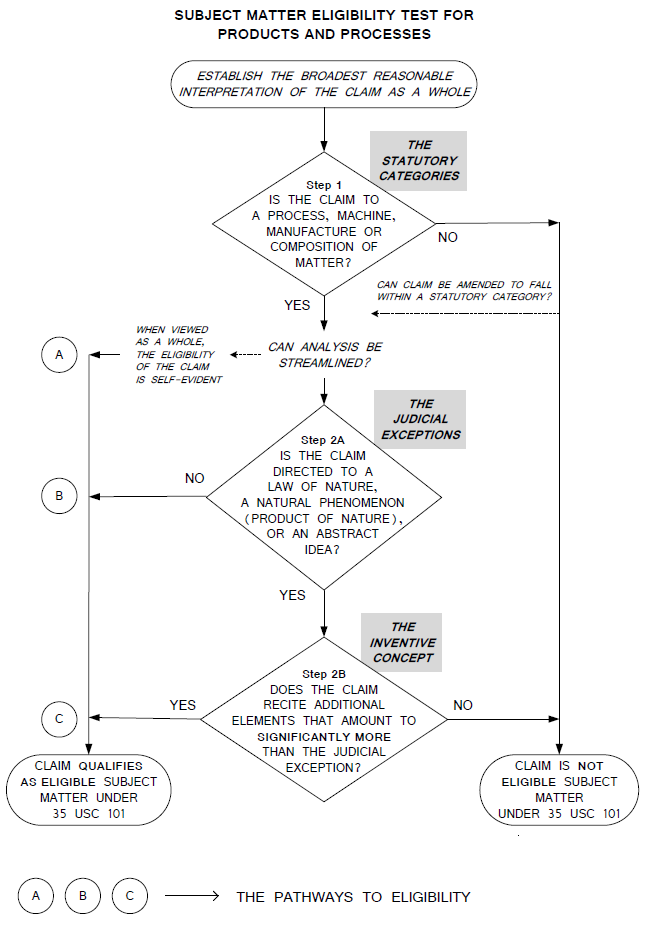
Examiners should determine whether a claim satisfies the criteria for subject matter eligibility by evaluating the claim in accordance with the following flowchart. The flowchart illustrates the steps of the subject matter eligibility analysis for products and processes that are to be used during examination for evaluating whether a claim is drawn to patent-eligible subject matter. It is recognized that under the controlling legal precedent there may be variations in the precise contours of the analysis for subject matter eligibility that will still achieve the same end result. The analysis set forth herein promotes examination efficiency and consistency across all technologies.
Examiners should determine whether a claim satisfies the criteria for subject matter eligibility by evaluating the claim in accordance with the following flowchart. The flowchart illustrates the steps of the subject matter eligibility analysis for products and processes that are to be used during examination for evaluating whether a claim is drawn to patent-eligible subject matter. It is recognized that under the controlling legal precedent there may be variations in the precise contours of the analysis for subject matter eligibility that will still achieve the same end result. The analysis set forth herein promotes examination efficiency and consistency across all technologies.
Examiners should determine whether a claim satisfies the criteria for subject matter eligibility by evaluating the claim in accordance with the following flowchart. The flowchart illustrates the steps of the subject matter eligibility analysis for products and processes that are to be used during examination for evaluating whether a claim is drawn to patent-eligible subject matter. It is recognized that under the controlling legal precedent there may be variations in the precise contours of the analysis for subject matter eligibility that will still achieve the same end result. The analysis set forth herein promotes examination efficiency and consistency across all technologies.
As shown in the flowchart, Step 1 relates to the statutory categories and ensures that the first criterion is met by confirming that the claim falls within one of the four statutory categories of invention. See MPEP § 2106.03 for more information on Step 1. Step 2, which is the Supreme Court’s Alice/Mayo test, is a two-part test to identify claims that are directed to a judicial exception (Step 2A) and to then evaluate if additional elements of the claim provide an inventive concept (Step 2B) (also called "significantly more" than the recited judicial exception). See MPEP § 2106.04 for more information on Step 2A and MPEP § 2106.05 for more information on Step 2B.
The flowchart also shows three pathways (A, B, and C) to eligibility:
- Pathway A: Claims taken as a whole that fall within a statutory category (Step 1: YES) and, which may or may not recite a judicial exception, but whose eligibility is self-evident can be found eligible at Pathway A using a streamlined analysis. See MPEP § 2106.06 for more information on this pathway and on self-evident eligibility.
- Pathway B: Claims taken as a whole that fall within a statutory category (Step 1: YES) and are not directed to a judicial exception (Step 2A: NO) are eligible at Pathway B. These claims do not need to go to Step 2B. See MPEP § 2106.04 for more information about this pathway and Step 2A.
- Pathway C: Claims taken as a whole that fall within a statutory category (Step 1: YES), are directed to a judicial exception (Step 2A: YES), and recite additional elements either individually or in an ordered combination that amount to significantly more than the judicial exception (Step 2B: YES) are eligible at Pathway C. See MPEP § 2106.05 for more information about this pathway and Step 2B.
The flowchart also shows three pathways (A, B, and C) to eligibility Pathway B: Claims taken as a whole that fall within a statutory category (Step 1: YES) and are not directed to a judicial exception (Step 2A: NO) are eligible at Pathway B. These claims do not need to go to Step 2B. See MPEP § 2106.04 for more information about this pathway and Step 2A.
The flowchart also shows three pathways (A, B, and C) to eligibility Pathway C: Claims taken as a whole that fall within a statutory category (Step 1: YES), are directed to a judicial exception (Step 2A: YES), and recite additional elements either individually or in an ordered combination that amount to significantly more than the judicial exception (Step 2B: YES) are eligible at Pathway C. See MPEP § 2106.05 for more information about this pathway and Step 2B.
Regardless of whether a rejection under 35 U.S.C. 101 is made, a complete examination should be made for every claim under each of the other patentability requirements: 35 U.S.C. 102, 103, 112, and 101 (utility, inventorship and double patenting) and non-statutory double patenting. MPEP § 2103.
Regardless of whether a rejection under 35 U.S.C. 101 is made, a complete examination should be made for every claim under each of the other patentability requirements: 35 U.S.C. 102, 103, 112, and 101 (utility, inventorship and double patenting) and non-statutory double patenting. MPEP § 2103.
Significantly More Analysis
Second, the claimed invention also must qualify as patent-eligible subject matter, i.e., the claim must not be directed to a judicial exception unless the claim as a whole includes additional limitations amounting to significantly more than the exception. The judicial exceptions (also called “judicially recognized exceptions” or simply “exceptions”) are subject matter that the courts have found to be outside of, or exceptions to, the four statutory categories of invention, and are limited to abstract ideas, laws of nature and natural phenomena (including products of nature). Alice Corp. Pty. Ltd. v. CLS Bank Int'l, 573 U.S. 208, 216, 110 USPQ2d 1976, 1980 (2014) (citing Ass'n for Molecular Pathology v. Myriad Genetics, Inc., 569 U.S. 576, 589, 106 USPQ2d 1972, 1979 (2013). See MPEP § 2106.04 for detailed information on the judicial exceptions.
With regard to the second criterion for eligibility, the Alice/Mayo test, claim interpretation can affect the first part of the test (whether the claims are directed to a judicial exception). For example, the patentee in Synopsys argued that the claimed methods of logic circuit design were intended to be used in conjunction with computer-based design tools, and were thus not mental processes. Synopsys, Inc. v. Mentor Graphics Corp., 839 F.3d 1138, 1147-49, 120 USPQ2d 1473, 1480-81 (Fed. Cir. 2016). The court disagreed, because it interpreted the claims as encompassing nothing other than pure mental steps (and thus falling within an abstract idea grouping) because the claims did not include any limitations requiring computer implementation. In contrast, the patentee in Enfish argued that its claimed self-referential table for a computer database was an improvement in an existing technology and thus not directed to an abstract idea. Enfish, LLC v. Microsoft Corp., 822 F.3d 1327, 1336-37, 118 USPQ2d 1684, 1689-90 (Fed. Cir. 2016). The court agreed with the patentee, based on its interpretation of the claimed “means for configuring” under 35 U.S.C. 112(f) as requiring a four-step algorithm that achieved the improvements, as opposed to merely any form of storing tabular data. See also McRO, Inc. v. Bandai Namco Games America, Inc. 837 F.3d 1299, 1314, 120 USPQ2d 1091, 1102 (Fed. Cir. 2016) (the claim’s construction incorporated rules of a particular type that improved an existing technological process). Claim interpretation can also affect the second part of the Alice/Mayo test (whether the claim recites additional elements that amount to significantly more than the judicial exception). For example, in Amdocs (Israel) Ltd. v. Openet Telecom, Inc., where the court relied on the construction of the term “enhance” (to require application of a number of field enhancements in a distributed fashion) to determine that the claim entails an unconventional technical solution to a technological problem. 841 F.3d 1288, 1300-01, 120 USPQ2d 1527, 1537 (Fed. Cir. 2016).
With regard to the second criterion for eligibility, the Alice/Mayo test, claim interpretation can affect the first part of the test (whether the claims are directed to a judicial exception). For example, the patentee in Synopsys argued that the claimed methods of logic circuit design were intended to be used in conjunction with computer-based design tools, and were thus not mental processes. Synopsys, Inc. v. Mentor Graphics Corp., 839 F.3d 1138, 1147-49, 120 USPQ2d 1473, 1480-81 (Fed. Cir. 2016). The court disagreed, because it interpreted the claims as encompassing nothing other than pure mental steps (and thus falling within an abstract idea grouping) because the claims did not include any limitations requiring computer implementation. In contrast, the patentee in Enfish argued that its claimed self-referential table for a computer database was an improvement in an existing technology and thus not directed to an abstract idea. Enfish, LLC v. Microsoft Corp., 822 F.3d 1327, 1336-37, 118 USPQ2d 1684, 1689-90 (Fed. Cir. 2016). The court agreed with the patentee, based on its interpretation of the claimed “means for configuring” under 35 U.S.C. 112(f) as requiring a four-step algorithm that achieved the improvements, as opposed to merely any form of storing tabular data. See also McRO, Inc. v. Bandai Namco Games America, Inc. 837 F.3d 1299, 1314, 120 USPQ2d 1091, 1102 (Fed. Cir. 2016) (the claim’s construction incorporated rules of a particular type that improved an existing technological process). Claim interpretation can also affect the second part of the Alice/Mayo test (whether the claim recites additional elements that amount to significantly more than the judicial exception). For example, in Amdocs (Israel) Ltd. v. Openet Telecom, Inc., where the court relied on the construction of the term “enhance” (to require application of a number of field enhancements in a distributed fashion) to determine that the claim entails an unconventional technical solution to a technological problem. 841 F.3d 1288, 1300-01, 120 USPQ2d 1527, 1537 (Fed. Cir. 2016).
As shown in the flowchart, Step 1 relates to the statutory categories and ensures that the first criterion is met by confirming that the claim falls within one of the four statutory categories of invention. See MPEP § 2106.03 for more information on Step 1. Step 2, which is the Supreme Court’s Alice/Mayo test, is a two-part test to identify claims that are directed to a judicial exception (Step 2A) and to then evaluate if additional elements of the claim provide an inventive concept (Step 2B) (also called "significantly more" than the recited judicial exception). See MPEP § 2106.04 for more information on Step 2A and MPEP § 2106.05 for more information on Step 2B.
The flowchart also shows three pathways (A, B, and C) to eligibility Pathway C: Claims taken as a whole that fall within a statutory category (Step 1: YES), are directed to a judicial exception (Step 2A: YES), and recite additional elements either individually or in an ordered combination that amount to significantly more than the judicial exception (Step 2B: YES) are eligible at Pathway C. See MPEP § 2106.05 for more information about this pathway and Step 2B.
Abstract Ideas
Because abstract ideas, laws of nature, and natural phenomenon "are the basic tools of scientific and technological work", the Supreme Court has expressed concern that monopolizing these tools by granting patent rights may impede innovation rather than promote it. See Alice Corp., 573 U.S. at 216, 110 USPQ2d at 1980; Mayo Collaborative Servs. v. Prometheus Labs., Inc., 566 U.S. 66, 71, 101 USPQ2d 1961, 1965 (2012). However, the Court has also emphasized that an invention is not considered to be ineligible for patenting simply because it involves a judicial exception. Alice Corp., 573 U.S. at 217, 110 USPQ2d at 1980-81 (citing Diamond v. Diehr, 450 U.S. 175, 187, 209 USPQ 1, 8 (1981)). See also Thales Visionix Inc. v. United States, 850 F.3d. 1343, 1349, 121 USPQ2d 1898, 1902 (Fed. Cir. 2017) (“That a mathematical equation is required to complete the claimed method and system does not doom the claims to abstraction.”). Accordingly, the Court has said that integration of an abstract idea, law of nature or natural phenomenon into a practical application may be eligible for patent protection. See, e.g., Alice, 573 U.S. at 217, 110 USPQ2d at 1981 (explaining that “in applying the §101 exception, we must distinguish between patents that claim the ‘buildin[g] block[s]’ of human ingenuity and those that integrate the building blocks into something more” (quoting Mayo, 566 U.S. at 89, 110 USPQ2d at 1971) and stating that Mayo “set forth a framework for distinguishing patents that claim laws of nature, natural phenomena, and abstract ideas from those that claim patent-eligible applications of those concepts”); Mayo, 566 U.S. at 80, 84, 101 USPQ2d at 1969, 1971 (noting that the Court in Diamond v. Diehr found “the overall process patent eligible because of the way the additional steps of the process integrated the equation into the process as a whole,” but the Court in Gottschalk v. Benson “held that simply implementing a mathematical principle on a physical machine, namely a computer, was not a patentable application of that principle”); Bilski v. Kappos, 561 U.S. 593, 611, 95 USPQ2d 1001, 1010 (2010) (“ Diehr explained that while an abstract idea, law of nature, or mathematical formula could not be patented, ‘an application of a law of nature or mathematical formula to a known structure or process may well be deserving of patent protection.’” (quoting Diamond v. Diehr, 450 U.S. 175, 187, 209 USPQ 1, 8 (1981)) (emphasis in original)); Diehr, 450 U.S. at 187, 192 n.14, 209 USPQ at 10 n.14 (explaining that the process in Parker v. Flook was ineligible not because it contained a mathematical formula, but because it did not provide an application of the formula). See Diamond v. Diehr, 450 U.S. 175, 209 USPQ 1 (1981); Gottschalk v. Benson, 409 U.S. 63, 175 USPQ 673 (1972); Parker v. Flook, 437 U.S. 584, 198 USPQ 193 (1978).
The Alice/Mayo two-part test is the only test that should be used to evaluate the eligibility of claims under examination. While the machine-or-transformation test is an important clue to eligibility, it should not be used as a separate test for eligibility. Instead it should be considered as part of the "integration" determination or "significantly more" determination articulated in the Alice/Mayo test. Bilski v. Kappos, 561 U.S. 593, 605, 95 USPQ2d 1001, 1007 (2010). See MPEP § 2106.04(d) for more information about evaluating whether a claim reciting a judicial exception is integrated into a practical application and MPEP § 2106.05(b) and MPEP § 2106.05(c) for more information about how the machine-or-transformation test fits into the Alice/Mayo two-part framework. Likewise, eligibility should not be evaluated based on whether the claim recites a "useful, concrete, and tangible result," State Street Bank, 149 F.3d 1368, 1374, 47 USPQ2d 1596, 1602 (Fed. Cir. 1998) (quoting In re Alappat, 33 F.3d 1526, 1544, 31 USPQ2d 1545, 1557 (Fed. Cir. 1994)), as this test has been superseded. In re Bilski, 545 F.3d 943, 959-60, 88 USPQ2d 1385, 1394-95 (Fed. Cir. 2008) (en banc), aff'd by Bilski v. Kappos, 561 U.S. 593, 95 USPQ2d 1001 (2010). See also TLI Communications LLC v. AV Automotive LLC, 823 F.3d 607, 613, 118 USPQ2d 1744, 1748 (Fed. Cir. 2016) (“It is well-settled that mere recitation of concrete, tangible components is insufficient to confer patent eligibility to an otherwise abstract idea”). The programmed computer or “special purpose computer” test of In re Alappat, 33 F.3d 1526, 31 USPQ2d 1545 (Fed. Cir. 1994) (i.e., the rationale that an otherwise ineligible algorithm or software could be made patent-eligible by merely adding a generic computer to the claim for the “special purpose” of executing the algorithm or software) was also superseded by the Supreme Court’s Bilski and Alice Corp. decisions. Eon Corp. IP Holdings LLC v. AT&T Mobility LLC, 785 F.3d 616, 623, 114 USPQ2d 1711, 1715 (Fed. Cir. 2015) (“[W]e note that Alappat has been superseded by Bilski, 561 U.S. at 605–06, and Alice Corp. v. CLS Bank Int’l, 573 U.S. 208, 110 USPQ2d 1976 (2014)”); Intellectual Ventures I LLC v. Capital One Bank (USA), N.A., 792 F.3d 1363, 1366, 115 USPQ2d 1636, 1639 (Fed. Cir. 2015) (“An abstract idea does not become nonabstract by limiting the invention to a particular field of use or technological environment, such as the Internet [or] a computer”). Lastly, eligibility should not be evaluated based on whether the claimed invention has utility, because “[u]tility is not the test for patent-eligible subject matter.” Genetic Techs. Ltd. v. Merial LLC, 818 F.3d 1369, 1380, 118 USPQ2d 1541, 1548 (Fed. Cir. 2016).
The Alice/Mayo two-part test is the only test that should be used to evaluate the eligibility of claims under examination. While the machine-or-transformation test is an important clue to eligibility, it should not be used as a separate test for eligibility. Instead it should be considered as part of the "integration" determination or "significantly more" determination articulated in the Alice/Mayo test. Bilski v. Kappos, 561 U.S. 593, 605, 95 USPQ2d 1001, 1007 (2010). See MPEP § 2106.04(d) for more information about evaluating whether a claim reciting a judicial exception is integrated into a practical application and MPEP § 2106.05(b) and MPEP § 2106.05(c) for more information about how the machine-or-transformation test fits into the Alice/Mayo two-part framework. Likewise, eligibility should not be evaluated based on whether the claim recites a "useful, concrete, and tangible result," State Street Bank, 149 F.3d 1368, 1374, 47 USPQ2d 1596, 1602 (Fed. Cir. 1998) (quoting In re Alappat, 33 F.3d 1526, 1544, 31 USPQ2d 1545, 1557 (Fed. Cir. 1994)), as this test has been superseded. In re Bilski, 545 F.3d 943, 959-60, 88 USPQ2d 1385, 1394-95 (Fed. Cir. 2008) (en banc), aff'd by Bilski v. Kappos, 561 U.S. 593, 95 USPQ2d 1001 (2010). See also TLI Communications LLC v. AV Automotive LLC, 823 F.3d 607, 613, 118 USPQ2d 1744, 1748 (Fed. Cir. 2016) (“It is well-settled that mere recitation of concrete, tangible components is insufficient to confer patent eligibility to an otherwise abstract idea”). The programmed computer or “special purpose computer” test of In re Alappat, 33 F.3d 1526, 31 USPQ2d 1545 (Fed. Cir. 1994) (i.e., the rationale that an otherwise ineligible algorithm or software could be made patent-eligible by merely adding a generic computer to the claim for the “special purpose” of executing the algorithm or software) was also superseded by the Supreme Court’s Bilski and Alice Corp. decisions. Eon Corp. IP Holdings LLC v. AT&T Mobility LLC, 785 F.3d 616, 623, 114 USPQ2d 1711, 1715 (Fed. Cir. 2015) (“[W]e note that Alappat has been superseded by Bilski, 561 U.S. at 605–06, and Alice Corp. v. CLS Bank Int’l, 573 U.S. 208, 110 USPQ2d 1976 (2014)”); Intellectual Ventures I LLC v. Capital One Bank (USA), N.A., 792 F.3d 1363, 1366, 115 USPQ2d 1636, 1639 (Fed. Cir. 2015) (“An abstract idea does not become nonabstract by limiting the invention to a particular field of use or technological environment, such as the Internet [or] a computer”). Lastly, eligibility should not be evaluated based on whether the claimed invention has utility, because “[u]tility is not the test for patent-eligible subject matter.” Genetic Techs. Ltd. v. Merial LLC, 818 F.3d 1369, 1380, 118 USPQ2d 1541, 1548 (Fed. Cir. 2016).
With regard to the second criterion for eligibility, the Alice/Mayo test, claim interpretation can affect the first part of the test (whether the claims are directed to a judicial exception). For example, the patentee in Synopsys argued that the claimed methods of logic circuit design were intended to be used in conjunction with computer-based design tools, and were thus not mental processes. Synopsys, Inc. v. Mentor Graphics Corp., 839 F.3d 1138, 1147-49, 120 USPQ2d 1473, 1480-81 (Fed. Cir. 2016). The court disagreed, because it interpreted the claims as encompassing nothing other than pure mental steps (and thus falling within an abstract idea grouping) because the claims did not include any limitations requiring computer implementation. In contrast, the patentee in Enfish argued that its claimed self-referential table for a computer database was an improvement in an existing technology and thus not directed to an abstract idea. Enfish, LLC v. Microsoft Corp., 822 F.3d 1327, 1336-37, 118 USPQ2d 1684, 1689-90 (Fed. Cir. 2016). The court agreed with the patentee, based on its interpretation of the claimed “means for configuring” under 35 U.S.C. 112(f) as requiring a four-step algorithm that achieved the improvements, as opposed to merely any form of storing tabular data. See also McRO, Inc. v. Bandai Namco Games America, Inc. 837 F.3d 1299, 1314, 120 USPQ2d 1091, 1102 (Fed. Cir. 2016) (the claim’s construction incorporated rules of a particular type that improved an existing technological process). Claim interpretation can also affect the second part of the Alice/Mayo test (whether the claim recites additional elements that amount to significantly more than the judicial exception). For example, in Amdocs (Israel) Ltd. v. Openet Telecom, Inc., where the court relied on the construction of the term “enhance” (to require application of a number of field enhancements in a distributed fashion) to determine that the claim entails an unconventional technical solution to a technological problem. 841 F.3d 1288, 1300-01, 120 USPQ2d 1527, 1537 (Fed. Cir. 2016).
Mathematical Concepts
Because abstract ideas, laws of nature, and natural phenomenon "are the basic tools of scientific and technological work", the Supreme Court has expressed concern that monopolizing these tools by granting patent rights may impede innovation rather than promote it. See Alice Corp., 573 U.S. at 216, 110 USPQ2d at 1980; Mayo Collaborative Servs. v. Prometheus Labs., Inc., 566 U.S. 66, 71, 101 USPQ2d 1961, 1965 (2012). However, the Court has also emphasized that an invention is not considered to be ineligible for patenting simply because it involves a judicial exception. Alice Corp., 573 U.S. at 217, 110 USPQ2d at 1980-81 (citing Diamond v. Diehr, 450 U.S. 175, 187, 209 USPQ 1, 8 (1981)). See also Thales Visionix Inc. v. United States, 850 F.3d. 1343, 1349, 121 USPQ2d 1898, 1902 (Fed. Cir. 2017) (“That a mathematical equation is required to complete the claimed method and system does not doom the claims to abstraction.”). Accordingly, the Court has said that integration of an abstract idea, law of nature or natural phenomenon into a practical application may be eligible for patent protection. See, e.g., Alice, 573 U.S. at 217, 110 USPQ2d at 1981 (explaining that “in applying the §101 exception, we must distinguish between patents that claim the ‘buildin[g] block[s]’ of human ingenuity and those that integrate the building blocks into something more” (quoting Mayo, 566 U.S. at 89, 110 USPQ2d at 1971) and stating that Mayo “set forth a framework for distinguishing patents that claim laws of nature, natural phenomena, and abstract ideas from those that claim patent-eligible applications of those concepts”); Mayo, 566 U.S. at 80, 84, 101 USPQ2d at 1969, 1971 (noting that the Court in Diamond v. Diehr found “the overall process patent eligible because of the way the additional steps of the process integrated the equation into the process as a whole,” but the Court in Gottschalk v. Benson “held that simply implementing a mathematical principle on a physical machine, namely a computer, was not a patentable application of that principle”); Bilski v. Kappos, 561 U.S. 593, 611, 95 USPQ2d 1001, 1010 (2010) (“ Diehr explained that while an abstract idea, law of nature, or mathematical formula could not be patented, ‘an application of a law of nature or mathematical formula to a known structure or process may well be deserving of patent protection.’” (quoting Diamond v. Diehr, 450 U.S. 175, 187, 209 USPQ 1, 8 (1981)) (emphasis in original)); Diehr, 450 U.S. at 187, 192 n.14, 209 USPQ at 10 n.14 (explaining that the process in Parker v. Flook was ineligible not because it contained a mathematical formula, but because it did not provide an application of the formula). See Diamond v. Diehr, 450 U.S. 175, 209 USPQ 1 (1981); Gottschalk v. Benson, 409 U.S. 63, 175 USPQ 673 (1972); Parker v. Flook, 437 U.S. 584, 198 USPQ 193 (1978).
Because abstract ideas, laws of nature, and natural phenomenon "are the basic tools of scientific and technological work", the Supreme Court has expressed concern that monopolizing these tools by granting patent rights may impede innovation rather than promote it. See Alice Corp., 573 U.S. at 216, 110 USPQ2d at 1980; Mayo Collaborative Servs. v. Prometheus Labs., Inc., 566 U.S. 66, 71, 101 USPQ2d 1961, 1965 (2012). However, the Court has also emphasized that an invention is not considered to be ineligible for patenting simply because it involves a judicial exception. Alice Corp., 573 U.S. at 217, 110 USPQ2d at 1980-81 (citing Diamond v. Diehr, 450 U.S. 175, 187, 209 USPQ 1, 8 (1981)). See also Thales Visionix Inc. v. United States, 850 F.3d. 1343, 1349, 121 USPQ2d 1898, 1902 (Fed. Cir. 2017) (“That a mathematical equation is required to complete the claimed method and system does not doom the claims to abstraction.”). Accordingly, the Court has said that integration of an abstract idea, law of nature or natural phenomenon into a practical application may be eligible for patent protection. See, e.g., Alice, 573 U.S. at 217, 110 USPQ2d at 1981 (explaining that “in applying the §101 exception, we must distinguish between patents that claim the ‘buildin[g] block[s]’ of human ingenuity and those that integrate the building blocks into something more” (quoting Mayo, 566 U.S. at 89, 110 USPQ2d at 1971) and stating that Mayo “set forth a framework for distinguishing patents that claim laws of nature, natural phenomena, and abstract ideas from those that claim patent-eligible applications of those concepts”); Mayo, 566 U.S. at 80, 84, 101 USPQ2d at 1969, 1971 (noting that the Court in Diamond v. Diehr found “the overall process patent eligible because of the way the additional steps of the process integrated the equation into the process as a whole,” but the Court in Gottschalk v. Benson “held that simply implementing a mathematical principle on a physical machine, namely a computer, was not a patentable application of that principle”); Bilski v. Kappos, 561 U.S. 593, 611, 95 USPQ2d 1001, 1010 (2010) (“ Diehr explained that while an abstract idea, law of nature, or mathematical formula could not be patented, ‘an application of a law of nature or mathematical formula to a known structure or process may well be deserving of patent protection.’” (quoting Diamond v. Diehr, 450 U.S. 175, 187, 209 USPQ 1, 8 (1981)) (emphasis in original)); Diehr, 450 U.S. at 187, 192 n.14, 209 USPQ at 10 n.14 (explaining that the process in Parker v. Flook was ineligible not because it contained a mathematical formula, but because it did not provide an application of the formula). See Diamond v. Diehr, 450 U.S. 175, 209 USPQ 1 (1981); Gottschalk v. Benson, 409 U.S. 63, 175 USPQ 673 (1972); Parker v. Flook, 437 U.S. 584, 198 USPQ 193 (1978).
The Alice/Mayo two-part test is the only test that should be used to evaluate the eligibility of claims under examination. While the machine-or-transformation test is an important clue to eligibility, it should not be used as a separate test for eligibility. Instead it should be considered as part of the "integration" determination or "significantly more" determination articulated in the Alice/Mayo test. Bilski v. Kappos, 561 U.S. 593, 605, 95 USPQ2d 1001, 1007 (2010). See MPEP § 2106.04(d) for more information about evaluating whether a claim reciting a judicial exception is integrated into a practical application and MPEP § 2106.05(b) and MPEP § 2106.05(c) for more information about how the machine-or-transformation test fits into the Alice/Mayo two-part framework. Likewise, eligibility should not be evaluated based on whether the claim recites a "useful, concrete, and tangible result," State Street Bank, 149 F.3d 1368, 1374, 47 USPQ2d 1596, 1602 (Fed. Cir. 1998) (quoting In re Alappat, 33 F.3d 1526, 1544, 31 USPQ2d 1545, 1557 (Fed. Cir. 1994)), as this test has been superseded. In re Bilski, 545 F.3d 943, 959-60, 88 USPQ2d 1385, 1394-95 (Fed. Cir. 2008) (en banc), aff'd by Bilski v. Kappos, 561 U.S. 593, 95 USPQ2d 1001 (2010). See also TLI Communications LLC v. AV Automotive LLC, 823 F.3d 607, 613, 118 USPQ2d 1744, 1748 (Fed. Cir. 2016) (“It is well-settled that mere recitation of concrete, tangible components is insufficient to confer patent eligibility to an otherwise abstract idea”). The programmed computer or “special purpose computer” test of In re Alappat, 33 F.3d 1526, 31 USPQ2d 1545 (Fed. Cir. 1994) (i.e., the rationale that an otherwise ineligible algorithm or software could be made patent-eligible by merely adding a generic computer to the claim for the “special purpose” of executing the algorithm or software) was also superseded by the Supreme Court’s Bilski and Alice Corp. decisions. Eon Corp. IP Holdings LLC v. AT&T Mobility LLC, 785 F.3d 616, 623, 114 USPQ2d 1711, 1715 (Fed. Cir. 2015) (“[W]e note that Alappat has been superseded by Bilski, 561 U.S. at 605–06, and Alice Corp. v. CLS Bank Int’l, 573 U.S. 208, 110 USPQ2d 1976 (2014)”); Intellectual Ventures I LLC v. Capital One Bank (USA), N.A., 792 F.3d 1363, 1366, 115 USPQ2d 1636, 1639 (Fed. Cir. 2015) (“An abstract idea does not become nonabstract by limiting the invention to a particular field of use or technological environment, such as the Internet [or] a computer”). Lastly, eligibility should not be evaluated based on whether the claimed invention has utility, because “[u]tility is not the test for patent-eligible subject matter.” Genetic Techs. Ltd. v. Merial LLC, 818 F.3d 1369, 1380, 118 USPQ2d 1541, 1548 (Fed. Cir. 2016).
With regard to the second criterion for eligibility, the Alice/Mayo test, claim interpretation can affect the first part of the test (whether the claims are directed to a judicial exception). For example, the patentee in Synopsys argued that the claimed methods of logic circuit design were intended to be used in conjunction with computer-based design tools, and were thus not mental processes. Synopsys, Inc. v. Mentor Graphics Corp., 839 F.3d 1138, 1147-49, 120 USPQ2d 1473, 1480-81 (Fed. Cir. 2016). The court disagreed, because it interpreted the claims as encompassing nothing other than pure mental steps (and thus falling within an abstract idea grouping) because the claims did not include any limitations requiring computer implementation. In contrast, the patentee in Enfish argued that its claimed self-referential table for a computer database was an improvement in an existing technology and thus not directed to an abstract idea. Enfish, LLC v. Microsoft Corp., 822 F.3d 1327, 1336-37, 118 USPQ2d 1684, 1689-90 (Fed. Cir. 2016). The court agreed with the patentee, based on its interpretation of the claimed “means for configuring” under 35 U.S.C. 112(f) as requiring a four-step algorithm that achieved the improvements, as opposed to merely any form of storing tabular data. See also McRO, Inc. v. Bandai Namco Games America, Inc. 837 F.3d 1299, 1314, 120 USPQ2d 1091, 1102 (Fed. Cir. 2016) (the claim’s construction incorporated rules of a particular type that improved an existing technological process). Claim interpretation can also affect the second part of the Alice/Mayo test (whether the claim recites additional elements that amount to significantly more than the judicial exception). For example, in Amdocs (Israel) Ltd. v. Openet Telecom, Inc., where the court relied on the construction of the term “enhance” (to require application of a number of field enhancements in a distributed fashion) to determine that the claim entails an unconventional technical solution to a technological problem. 841 F.3d 1288, 1300-01, 120 USPQ2d 1527, 1537 (Fed. Cir. 2016).
Alice/Mayo Two-Step Framework
Second, the claimed invention also must qualify as patent-eligible subject matter, i.e., the claim must not be directed to a judicial exception unless the claim as a whole includes additional limitations amounting to significantly more than the exception. The judicial exceptions (also called “judicially recognized exceptions” or simply “exceptions”) are subject matter that the courts have found to be outside of, or exceptions to, the four statutory categories of invention, and are limited to abstract ideas, laws of nature and natural phenomena (including products of nature). Alice Corp. Pty. Ltd. v. CLS Bank Int'l, 573 U.S. 208, 216, 110 USPQ2d 1976, 1980 (2014) (citing Ass'n for Molecular Pathology v. Myriad Genetics, Inc., 569 U.S. 576, 589, 106 USPQ2d 1972, 1979 (2013). See MPEP § 2106.04 for detailed information on the judicial exceptions.
The Alice/Mayo two-part test is the only test that should be used to evaluate the eligibility of claims under examination. While the machine-or-transformation test is an important clue to eligibility, it should not be used as a separate test for eligibility. Instead it should be considered as part of the "integration" determination or "significantly more" determination articulated in the Alice/Mayo test. Bilski v. Kappos, 561 U.S. 593, 605, 95 USPQ2d 1001, 1007 (2010). See MPEP § 2106.04(d) for more information about evaluating whether a claim reciting a judicial exception is integrated into a practical application and MPEP § 2106.05(b) and MPEP § 2106.05(c) for more information about how the machine-or-transformation test fits into the Alice/Mayo two-part framework. Likewise, eligibility should not be evaluated based on whether the claim recites a "useful, concrete, and tangible result," State Street Bank, 149 F.3d 1368, 1374, 47 USPQ2d 1596, 1602 (Fed. Cir. 1998) (quoting In re Alappat, 33 F.3d 1526, 1544, 31 USPQ2d 1545, 1557 (Fed. Cir. 1994)), as this test has been superseded. In re Bilski, 545 F.3d 943, 959-60, 88 USPQ2d 1385, 1394-95 (Fed. Cir. 2008) (en banc), aff'd by Bilski v. Kappos, 561 U.S. 593, 95 USPQ2d 1001 (2010). See also TLI Communications LLC v. AV Automotive LLC, 823 F.3d 607, 613, 118 USPQ2d 1744, 1748 (Fed. Cir. 2016) (“It is well-settled that mere recitation of concrete, tangible components is insufficient to confer patent eligibility to an otherwise abstract idea”). The programmed computer or “special purpose computer” test of In re Alappat, 33 F.3d 1526, 31 USPQ2d 1545 (Fed. Cir. 1994) (i.e., the rationale that an otherwise ineligible algorithm or software could be made patent-eligible by merely adding a generic computer to the claim for the “special purpose” of executing the algorithm or software) was also superseded by the Supreme Court’s Bilski and Alice Corp. decisions. Eon Corp. IP Holdings LLC v. AT&T Mobility LLC, 785 F.3d 616, 623, 114 USPQ2d 1711, 1715 (Fed. Cir. 2015) (“[W]e note that Alappat has been superseded by Bilski, 561 U.S. at 605–06, and Alice Corp. v. CLS Bank Int’l, 573 U.S. 208, 110 USPQ2d 1976 (2014)”); Intellectual Ventures I LLC v. Capital One Bank (USA), N.A., 792 F.3d 1363, 1366, 115 USPQ2d 1636, 1639 (Fed. Cir. 2015) (“An abstract idea does not become nonabstract by limiting the invention to a particular field of use or technological environment, such as the Internet [or] a computer”). Lastly, eligibility should not be evaluated based on whether the claimed invention has utility, because “[u]tility is not the test for patent-eligible subject matter.” Genetic Techs. Ltd. v. Merial LLC, 818 F.3d 1369, 1380, 118 USPQ2d 1541, 1548 (Fed. Cir. 2016).
The flowchart also shows three pathways (A, B, and C) to eligibility Pathway B: Claims taken as a whole that fall within a statutory category (Step 1: YES) and are not directed to a judicial exception (Step 2A: NO) are eligible at Pathway B. These claims do not need to go to Step 2B. See MPEP § 2106.04 for more information about this pathway and Step 2A.
Machine
Because abstract ideas, laws of nature, and natural phenomenon "are the basic tools of scientific and technological work", the Supreme Court has expressed concern that monopolizing these tools by granting patent rights may impede innovation rather than promote it. See Alice Corp., 573 U.S. at 216, 110 USPQ2d at 1980; Mayo Collaborative Servs. v. Prometheus Labs., Inc., 566 U.S. 66, 71, 101 USPQ2d 1961, 1965 (2012). However, the Court has also emphasized that an invention is not considered to be ineligible for patenting simply because it involves a judicial exception. Alice Corp., 573 U.S. at 217, 110 USPQ2d at 1980-81 (citing Diamond v. Diehr, 450 U.S. 175, 187, 209 USPQ 1, 8 (1981)). See also Thales Visionix Inc. v. United States, 850 F.3d. 1343, 1349, 121 USPQ2d 1898, 1902 (Fed. Cir. 2017) (“That a mathematical equation is required to complete the claimed method and system does not doom the claims to abstraction.”). Accordingly, the Court has said that integration of an abstract idea, law of nature or natural phenomenon into a practical application may be eligible for patent protection. See, e.g., Alice, 573 U.S. at 217, 110 USPQ2d at 1981 (explaining that “in applying the §101 exception, we must distinguish between patents that claim the ‘buildin[g] block[s]’ of human ingenuity and those that integrate the building blocks into something more” (quoting Mayo, 566 U.S. at 89, 110 USPQ2d at 1971) and stating that Mayo “set forth a framework for distinguishing patents that claim laws of nature, natural phenomena, and abstract ideas from those that claim patent-eligible applications of those concepts”); Mayo, 566 U.S. at 80, 84, 101 USPQ2d at 1969, 1971 (noting that the Court in Diamond v. Diehr found “the overall process patent eligible because of the way the additional steps of the process integrated the equation into the process as a whole,” but the Court in Gottschalk v. Benson “held that simply implementing a mathematical principle on a physical machine, namely a computer, was not a patentable application of that principle”); Bilski v. Kappos, 561 U.S. 593, 611, 95 USPQ2d 1001, 1010 (2010) (“ Diehr explained that while an abstract idea, law of nature, or mathematical formula could not be patented, ‘an application of a law of nature or mathematical formula to a known structure or process may well be deserving of patent protection.’” (quoting Diamond v. Diehr, 450 U.S. 175, 187, 209 USPQ 1, 8 (1981)) (emphasis in original)); Diehr, 450 U.S. at 187, 192 n.14, 209 USPQ at 10 n.14 (explaining that the process in Parker v. Flook was ineligible not because it contained a mathematical formula, but because it did not provide an application of the formula). See Diamond v. Diehr, 450 U.S. 175, 209 USPQ 1 (1981); Gottschalk v. Benson, 409 U.S. 63, 175 USPQ 673 (1972); Parker v. Flook, 437 U.S. 584, 198 USPQ 193 (1978).
Claim interpretation affects the evaluation of both criteria for eligibility. For example, in Mentor Graphics v. EVE-USA, Inc., 851 F.3d 1275, 112 USPQ2d 1120 (Fed. Cir. 2017), claim interpretation was crucial to the court’s determination that claims to a “machine-readable medium” were not to a statutory category. In Mentor Graphics, the court interpreted the claims in light of the specification, which expressly defined the medium as encompassing “any data storage device” including random-access memory and carrier waves. Although random-access memory and magnetic tape are statutory media, carrier waves are not because they are signals similar to the transitory, propagating signals held to be non-statutory in Nuijten. 851 F.3d at 1294, 112 USPQ2d at 1133 (citing In re Nuijten, 500 F.3d 1346, 84 USPQ2d 1495 (Fed. Cir. 2007)). Accordingly, because the BRI of the claims covered both subject matter that falls within a statutory category (the random-access memory), as well as subject matter that does not (the carrier waves), the claims as a whole were not to a statutory category and thus failed the first criterion for eligibility.
Claim interpretation affects the evaluation of both criteria for eligibility. For example, in Mentor Graphics v. EVE-USA, Inc., 851 F.3d 1275, 112 USPQ2d 1120 (Fed. Cir. 2017), claim interpretation was crucial to the court’s determination that claims to a “machine-readable medium” were not to a statutory category. In Mentor Graphics, the court interpreted the claims in light of the specification, which expressly defined the medium as encompassing “any data storage device” including random-access memory and carrier waves. Although random-access memory and magnetic tape are statutory media, carrier waves are not because they are signals similar to the transitory, propagating signals held to be non-statutory in Nuijten. 851 F.3d at 1294, 112 USPQ2d at 1133 (citing In re Nuijten, 500 F.3d 1346, 84 USPQ2d 1495 (Fed. Cir. 2007)). Accordingly, because the BRI of the claims covered both subject matter that falls within a statutory category (the random-access memory), as well as subject matter that does not (the carrier waves), the claims as a whole were not to a statutory category and thus failed the first criterion for eligibility.
Step 2A Prong 1 – Judicial Exception
With regard to the second criterion for eligibility, the Alice/Mayo test, claim interpretation can affect the first part of the test (whether the claims are directed to a judicial exception). For example, the patentee in Synopsys argued that the claimed methods of logic circuit design were intended to be used in conjunction with computer-based design tools, and were thus not mental processes. Synopsys, Inc. v. Mentor Graphics Corp., 839 F.3d 1138, 1147-49, 120 USPQ2d 1473, 1480-81 (Fed. Cir. 2016). The court disagreed, because it interpreted the claims as encompassing nothing other than pure mental steps (and thus falling within an abstract idea grouping) because the claims did not include any limitations requiring computer implementation. In contrast, the patentee in Enfish argued that its claimed self-referential table for a computer database was an improvement in an existing technology and thus not directed to an abstract idea. Enfish, LLC v. Microsoft Corp., 822 F.3d 1327, 1336-37, 118 USPQ2d 1684, 1689-90 (Fed. Cir. 2016). The court agreed with the patentee, based on its interpretation of the claimed “means for configuring” under 35 U.S.C. 112(f) as requiring a four-step algorithm that achieved the improvements, as opposed to merely any form of storing tabular data. See also McRO, Inc. v. Bandai Namco Games America, Inc. 837 F.3d 1299, 1314, 120 USPQ2d 1091, 1102 (Fed. Cir. 2016) (the claim’s construction incorporated rules of a particular type that improved an existing technological process). Claim interpretation can also affect the second part of the Alice/Mayo test (whether the claim recites additional elements that amount to significantly more than the judicial exception). For example, in Amdocs (Israel) Ltd. v. Openet Telecom, Inc., where the court relied on the construction of the term “enhance” (to require application of a number of field enhancements in a distributed fashion) to determine that the claim entails an unconventional technical solution to a technological problem. 841 F.3d 1288, 1300-01, 120 USPQ2d 1527, 1537 (Fed. Cir. 2016).
With regard to the second criterion for eligibility, the Alice/Mayo test, claim interpretation can affect the first part of the test (whether the claims are directed to a judicial exception). For example, the patentee in Synopsys argued that the claimed methods of logic circuit design were intended to be used in conjunction with computer-based design tools, and were thus not mental processes. Synopsys, Inc. v. Mentor Graphics Corp., 839 F.3d 1138, 1147-49, 120 USPQ2d 1473, 1480-81 (Fed. Cir. 2016). The court disagreed, because it interpreted the claims as encompassing nothing other than pure mental steps (and thus falling within an abstract idea grouping) because the claims did not include any limitations requiring computer implementation. In contrast, the patentee in Enfish argued that its claimed self-referential table for a computer database was an improvement in an existing technology and thus not directed to an abstract idea. Enfish, LLC v. Microsoft Corp., 822 F.3d 1327, 1336-37, 118 USPQ2d 1684, 1689-90 (Fed. Cir. 2016). The court agreed with the patentee, based on its interpretation of the claimed “means for configuring” under 35 U.S.C. 112(f) as requiring a four-step algorithm that achieved the improvements, as opposed to merely any form of storing tabular data. See also McRO, Inc. v. Bandai Namco Games America, Inc. 837 F.3d 1299, 1314, 120 USPQ2d 1091, 1102 (Fed. Cir. 2016) (the claim’s construction incorporated rules of a particular type that improved an existing technological process). Claim interpretation can also affect the second part of the Alice/Mayo test (whether the claim recites additional elements that amount to significantly more than the judicial exception). For example, in Amdocs (Israel) Ltd. v. Openet Telecom, Inc., where the court relied on the construction of the term “enhance” (to require application of a number of field enhancements in a distributed fashion) to determine that the claim entails an unconventional technical solution to a technological problem. 841 F.3d 1288, 1300-01, 120 USPQ2d 1527, 1537 (Fed. Cir. 2016).
The flowchart also shows three pathways (A, B, and C) to eligibility Pathway B: Claims taken as a whole that fall within a statutory category (Step 1: YES) and are not directed to a judicial exception (Step 2A: NO) are eligible at Pathway B. These claims do not need to go to Step 2B. See MPEP § 2106.04 for more information about this pathway and Step 2A.
Composition of Matter
First, the claimed invention must be to one of the four statutory categories. 35 U.S.C. 101 defines the four categories of invention that Congress deemed to be the appropriate subject matter of a patent: processes, machines, manufactures and compositions of matter. The latter three categories define “things” or “products” while the first category defines “actions” (i.e., inventions that consist of a series of steps or acts to be performed). See 35 U.S.C. 100(b) (“The term ‘process’ means process, art, or method, and includes a new use of a known process, machine, manufacture, composition of matter, or material.”). See MPEP § 2106.03 for detailed information on the four categories.
The § 101 patent-eligibility inquiry is only a threshold test. Even if an invention qualifies as a process, machine, manufacture, or composition of matter, in order to receive the Patent Act’s protection the claimed invention must also satisfy ‘‘the conditions and requirements of this title.’’ § 101. Those requirements include that the invention be novel, see § 102, nonobvious, see § 103, and fully and particularly described, see § 112.
Streamlined Eligibility Analysis
The flowchart also shows three pathways (A, B, and C) to eligibility Pathway A: Claims taken as a whole that fall within a statutory category (Step 1: YES) and, which may or may not recite a judicial exception, but whose eligibility is self-evident can be found eligible at Pathway A using a streamlined analysis. See MPEP § 2106.06 for more information on this pathway and on self-evident eligibility.
Claims that could have been found eligible at Pathway A (streamlined analysis), but are subjected to further analysis at Steps 2A or Step 2B, will ultimately be found eligible at Pathways B or C. Thus, if the examiner is uncertain about whether a streamlined analysis is appropriate, the examiner is encouraged to conduct a full eligibility analysis. However, if the claim is not found eligible at any of Pathways A, B or C, the claim is patent ineligible and should be rejected under 35 U.S.C. 101.
35 U.S.C. 101 – Patent Eligibility
First, the claimed invention must be to one of the four statutory categories. 35 U.S.C. 101 defines the four categories of invention that Congress deemed to be the appropriate subject matter of a patent: processes, machines, manufactures and compositions of matter. The latter three categories define “things” or “products” while the first category defines “actions” (i.e., inventions that consist of a series of steps or acts to be performed). See 35 U.S.C. 100(b) (“The term ‘process’ means process, art, or method, and includes a new use of a known process, machine, manufacture, composition of matter, or material.”). See MPEP § 2106.03 for detailed information on the four categories.
Judicial Exceptions to Eligibility
Because abstract ideas, laws of nature, and natural phenomenon "are the basic tools of scientific and technological work", the Supreme Court has expressed concern that monopolizing these tools by granting patent rights may impede innovation rather than promote it. See Alice Corp., 573 U.S. at 216, 110 USPQ2d at 1980; Mayo Collaborative Servs. v. Prometheus Labs., Inc., 566 U.S. 66, 71, 101 USPQ2d 1961, 1965 (2012). However, the Court has also emphasized that an invention is not considered to be ineligible for patenting simply because it involves a judicial exception. Alice Corp., 573 U.S. at 217, 110 USPQ2d at 1980-81 (citing Diamond v. Diehr, 450 U.S. 175, 187, 209 USPQ 1, 8 (1981)). See also Thales Visionix Inc. v. United States, 850 F.3d. 1343, 1349, 121 USPQ2d 1898, 1902 (Fed. Cir. 2017) (“That a mathematical equation is required to complete the claimed method and system does not doom the claims to abstraction.”). Accordingly, the Court has said that integration of an abstract idea, law of nature or natural phenomenon into a practical application may be eligible for patent protection. See, e.g., Alice, 573 U.S. at 217, 110 USPQ2d at 1981 (explaining that “in applying the §101 exception, we must distinguish between patents that claim the ‘buildin[g] block[s]’ of human ingenuity and those that integrate the building blocks into something more” (quoting Mayo, 566 U.S. at 89, 110 USPQ2d at 1971) and stating that Mayo “set forth a framework for distinguishing patents that claim laws of nature, natural phenomena, and abstract ideas from those that claim patent-eligible applications of those concepts”); Mayo, 566 U.S. at 80, 84, 101 USPQ2d at 1969, 1971 (noting that the Court in Diamond v. Diehr found “the overall process patent eligible because of the way the additional steps of the process integrated the equation into the process as a whole,” but the Court in Gottschalk v. Benson “held that simply implementing a mathematical principle on a physical machine, namely a computer, was not a patentable application of that principle”); Bilski v. Kappos, 561 U.S. 593, 611, 95 USPQ2d 1001, 1010 (2010) (“ Diehr explained that while an abstract idea, law of nature, or mathematical formula could not be patented, ‘an application of a law of nature or mathematical formula to a known structure or process may well be deserving of patent protection.’” (quoting Diamond v. Diehr, 450 U.S. 175, 187, 209 USPQ 1, 8 (1981)) (emphasis in original)); Diehr, 450 U.S. at 187, 192 n.14, 209 USPQ at 10 n.14 (explaining that the process in Parker v. Flook was ineligible not because it contained a mathematical formula, but because it did not provide an application of the formula). See Diamond v. Diehr, 450 U.S. 175, 209 USPQ 1 (1981); Gottschalk v. Benson, 409 U.S. 63, 175 USPQ 673 (1972); Parker v. Flook, 437 U.S. 584, 198 USPQ 193 (1978).
Machine-or-Transformation Test
The Alice/Mayo two-part test is the only test that should be used to evaluate the eligibility of claims under examination. While the machine-or-transformation test is an important clue to eligibility, it should not be used as a separate test for eligibility. Instead it should be considered as part of the "integration" determination or "significantly more" determination articulated in the Alice/Mayo test. Bilski v. Kappos, 561 U.S. 593, 605, 95 USPQ2d 1001, 1007 (2010). See MPEP § 2106.04(d) for more information about evaluating whether a claim reciting a judicial exception is integrated into a practical application and MPEP § 2106.05(b) and MPEP § 2106.05(c) for more information about how the machine-or-transformation test fits into the Alice/Mayo two-part framework. Likewise, eligibility should not be evaluated based on whether the claim recites a "useful, concrete, and tangible result," State Street Bank, 149 F.3d 1368, 1374, 47 USPQ2d 1596, 1602 (Fed. Cir. 1998) (quoting In re Alappat, 33 F.3d 1526, 1544, 31 USPQ2d 1545, 1557 (Fed. Cir. 1994)), as this test has been superseded. In re Bilski, 545 F.3d 943, 959-60, 88 USPQ2d 1385, 1394-95 (Fed. Cir. 2008) (en banc), aff'd by Bilski v. Kappos, 561 U.S. 593, 95 USPQ2d 1001 (2010). See also TLI Communications LLC v. AV Automotive LLC, 823 F.3d 607, 613, 118 USPQ2d 1744, 1748 (Fed. Cir. 2016) (“It is well-settled that mere recitation of concrete, tangible components is insufficient to confer patent eligibility to an otherwise abstract idea”). The programmed computer or “special purpose computer” test of In re Alappat, 33 F.3d 1526, 31 USPQ2d 1545 (Fed. Cir. 1994) (i.e., the rationale that an otherwise ineligible algorithm or software could be made patent-eligible by merely adding a generic computer to the claim for the “special purpose” of executing the algorithm or software) was also superseded by the Supreme Court’s Bilski and Alice Corp. decisions. Eon Corp. IP Holdings LLC v. AT&T Mobility LLC, 785 F.3d 616, 623, 114 USPQ2d 1711, 1715 (Fed. Cir. 2015) (“[W]e note that Alappat has been superseded by Bilski, 561 U.S. at 605–06, and Alice Corp. v. CLS Bank Int’l, 573 U.S. 208, 110 USPQ2d 1976 (2014)”); Intellectual Ventures I LLC v. Capital One Bank (USA), N.A., 792 F.3d 1363, 1366, 115 USPQ2d 1636, 1639 (Fed. Cir. 2015) (“An abstract idea does not become nonabstract by limiting the invention to a particular field of use or technological environment, such as the Internet [or] a computer”). Lastly, eligibility should not be evaluated based on whether the claimed invention has utility, because “[u]tility is not the test for patent-eligible subject matter.” Genetic Techs. Ltd. v. Merial LLC, 818 F.3d 1369, 1380, 118 USPQ2d 1541, 1548 (Fed. Cir. 2016).
Interpreting Claims (MPEP 2173.01)
Claim interpretation affects the evaluation of both criteria for eligibility. For example, in Mentor Graphics v. EVE-USA, Inc., 851 F.3d 1275, 112 USPQ2d 1120 (Fed. Cir. 2017), claim interpretation was crucial to the court’s determination that claims to a “machine-readable medium” were not to a statutory category. In Mentor Graphics, the court interpreted the claims in light of the specification, which expressly defined the medium as encompassing “any data storage device” including random-access memory and carrier waves. Although random-access memory and magnetic tape are statutory media, carrier waves are not because they are signals similar to the transitory, propagating signals held to be non-statutory in Nuijten. 851 F.3d at 1294, 112 USPQ2d at 1133 (citing In re Nuijten, 500 F.3d 1346, 84 USPQ2d 1495 (Fed. Cir. 2007)). Accordingly, because the BRI of the claims covered both subject matter that falls within a statutory category (the random-access memory), as well as subject matter that does not (the carrier waves), the claims as a whole were not to a statutory category and thus failed the first criterion for eligibility.
Statutory Categories of Invention
Claim interpretation affects the evaluation of both criteria for eligibility. For example, in Mentor Graphics v. EVE-USA, Inc., 851 F.3d 1275, 112 USPQ2d 1120 (Fed. Cir. 2017), claim interpretation was crucial to the court’s determination that claims to a “machine-readable medium” were not to a statutory category. In Mentor Graphics, the court interpreted the claims in light of the specification, which expressly defined the medium as encompassing “any data storage device” including random-access memory and carrier waves. Although random-access memory and magnetic tape are statutory media, carrier waves are not because they are signals similar to the transitory, propagating signals held to be non-statutory in Nuijten. 851 F.3d at 1294, 112 USPQ2d at 1133 (citing In re Nuijten, 500 F.3d 1346, 84 USPQ2d 1495 (Fed. Cir. 2007)). Accordingly, because the BRI of the claims covered both subject matter that falls within a statutory category (the random-access memory), as well as subject matter that does not (the carrier waves), the claims as a whole were not to a statutory category and thus failed the first criterion for eligibility.
Citations
| Primary topic | Citation |
|---|---|
| 35 U.S.C. 101 – Patent Eligibility Composition of Matter Patent Eligibility | 35 U.S.C. § 100(b) |
| 35 U.S.C. 101 – Patent Eligibility Abstract Ideas Composition of Matter Judicial Exceptions to Eligibility Machine Mathematical Concepts Patent Eligibility Streamlined Eligibility Analysis | 35 U.S.C. § 101 |
| Composition of Matter Patent Eligibility | 35 U.S.C. § 102 |
| Composition of Matter Patent Eligibility | 35 U.S.C. § 103 |
| Composition of Matter Patent Eligibility | 35 U.S.C. § 112 |
| Abstract Ideas Mathematical Concepts Patent Eligibility Significantly More Analysis Step 2A Prong 1 – Judicial Exception | 35 U.S.C. § 112(f) |
| Patent Eligibility | MPEP § 2103 |
| 35 U.S.C. 101 – Patent Eligibility Composition of Matter Patent Eligibility Significantly More Analysis | MPEP § 2106.03 |
| Alice/Mayo Two-Step Framework Patent Eligibility Significantly More Analysis Step 2A Prong 1 – Judicial Exception | MPEP § 2106.04 |
| Abstract Ideas Alice/Mayo Two-Step Framework Machine-or-Transformation Test Mathematical Concepts Patent Eligibility | MPEP § 2106.04(d) |
| Patent Eligibility Significantly More Analysis | MPEP § 2106.05 |
| Abstract Ideas Alice/Mayo Two-Step Framework Machine-or-Transformation Test Mathematical Concepts Patent Eligibility | MPEP § 2106.05(b) |
| Abstract Ideas Alice/Mayo Two-Step Framework Machine-or-Transformation Test Mathematical Concepts Patent Eligibility | MPEP § 2106.05(c) |
| Patent Eligibility Streamlined Eligibility Analysis | MPEP § 2106.06 |
| Patent Eligibility | MPEP § 2111 |
| Abstract Ideas Alice/Mayo Two-Step Framework Judicial Exceptions to Eligibility Machine Machine-or-Transformation Test Mathematical Concepts Patent Eligibility | Bilski v. Kappos, 561 U.S. 593, 605, 95 USPQ2d 1001, 1007 (2010) |
| Abstract Ideas Judicial Exceptions to Eligibility Machine Mathematical Concepts Patent Eligibility | Gottschalk v. Benson, 409 U.S. 63, 175 USPQ 673 (1972) |
| Abstract Ideas Alice/Mayo Two-Step Framework Machine-or-Transformation Test Mathematical Concepts Patent Eligibility | In re Alappat, 33 F.3d 1526, 31 USPQ2d 1545 (Fed. Cir. 1994) |
| Patent Eligibility | In re Bilski, 545 F.3d 943, 951, 88 USPQ2d 1385, 1388 (Fed. Cir. 2008) |
| Interpreting Claims (MPEP 2173.01) Machine Patent Eligibility Statutory Categories of Invention | In re Nuijten, 500 F.3d 1346, 84 USPQ2d 1495 (Fed. Cir. 2007) |
| Abstract Ideas Judicial Exceptions to Eligibility Machine Mathematical Concepts Patent Eligibility | Parker v. Flook, 437 U.S. 584, 198 USPQ 193 (1978) |
| Abstract Ideas Judicial Exceptions to Eligibility Machine Mathematical Concepts Patent Eligibility | See Diamond v. Diehr, 450 U.S. 175, 209 USPQ 1 (1981) |
| Patent Eligibility | See MyMail, Ltd. v. ooVoo, LLC, 934 F.3d 1373, 1379, 2019 USPQ2d 305789 (Fed. Cir. 2019) |
| Abstract Ideas Mathematical Concepts Patent Eligibility Significantly More Analysis Step 2A Prong 1 – Judicial Exception | See also McRO, Inc. v. Bandai Namco Games America, Inc. 837 F.3d 1299, 1314, 120 USPQ2d 1091, 1102 (Fed. Cir. 2016) |
| Abstract Ideas Alice/Mayo Two-Step Framework Machine-or-Transformation Test Mathematical Concepts Patent Eligibility | See also TLI Communications LLC v. AV Automotive LLC, 823 F.3d 607, 613, 118 USPQ2d 1744, 1748 (Fed. Cir. 2016) |
| Abstract Ideas Alice/Mayo Two-Step Framework Machine-or-Transformation Test Mathematical Concepts Patent Eligibility | aff'd by Bilski v. Kappos, 561 U.S. 593, 95 USPQ2d 1001 (2010) |
| Alice/Mayo Two-Step Framework Patent Eligibility Significantly More Analysis | citing Ass'n for Molecular Pathology v. Myriad Genetics, Inc., 569 U.S. 576, 589, 106 USPQ2d 1972, 1979 (2013) |
| Abstract Ideas Judicial Exceptions to Eligibility Machine Mathematical Concepts Patent Eligibility | citing Diamond v. Diehr, 450 U.S. 175, 187, 209 USPQ 1, 8 (1981) |
| Patent Eligibility | citing Parker v. Flook, 437 U.S. 584, 593, 198 USPQ 193, 198 (1978) |
| Interpreting Claims (MPEP 2173.01) Machine Patent Eligibility Statutory Categories of Invention | in Mentor Graphics v. EVE-USA, Inc., 851 F.3d 1275, 112 USPQ2d 1120 (Fed. Cir. 2017) |
| Abstract Ideas Judicial Exceptions to Eligibility Machine Mathematical Concepts Patent Eligibility | quoting Diamond v. Diehr, 450 U.S. 175, 187, 209 USPQ 1, 8 (1981) |
Source Text from USPTO’s MPEP
This is an exact copy of the MPEP from the USPTO. It is here for your reference to see the section in context.
Official MPEP § 2106 — Patent Subject Matter Eligibility
Source: USPTO2106 Patent Subject Matter Eligibility [R-10.2019]
I. Two Criteria For Subject Matter Eligibility
First, the claimed invention must be to one of the four statutory categories. 35 U.S.C. 101 defines the four categories of invention that Congress deemed to be the appropriate subject matter of a patent: processes, machines, manufactures and compositions of matter. The latter three categories define “things” or “products” while the first category defines “actions” (i.e., inventions that consist of a series of steps or acts to be performed). See 35 U.S.C. 100(b) (“The term ‘process’ means process, art, or method, and includes a new use of a known process, machine, manufacture, composition of matter, or material.”). See MPEP § 2106.03 for detailed information on the four categories.
Second, the claimed invention also must qualify as patent-eligible subject matter, i.e., the claim must not be directed to a judicial exception unless the claim as a whole includes additional limitations amounting to significantly more than the exception. The judicial exceptions (also called “judicially recognized exceptions” or simply “exceptions”) are subject matter that the courts have found to be outside of, or exceptions to, the four statutory categories of invention, and are limited to abstract ideas, laws of nature and natural phenomena (including products of nature). Alice Corp. Pty. Ltd. v. CLS Bank Int’l, 573 U.S. 208, 216, 110 USPQ2d 1976, 1980 (2014) (citing Ass’n for Molecular Pathology v. Myriad Genetics, Inc., 569 U.S. 576, 589, 106 USPQ2d 1972, 1979 (2013). See MPEP § 2106.04 for detailed information on the judicial exceptions.
Because abstract ideas, laws of nature, and natural phenomenon “are the basic tools of scientific and technological work”, the Supreme Court has expressed concern that monopolizing these tools by granting patent rights may impede innovation rather than promote it. See Alice Corp., 573 U.S. at 216, 110 USPQ2d at 1980; Mayo Collaborative Servs. v. Prometheus Labs., Inc., 566 U.S. 66, 71, 101 USPQ2d 1961, 1965 (2012). However, the Court has also emphasized that an invention is not considered to be ineligible for patenting simply because it involves a judicial exception. Alice Corp., 573 U.S. at 217, 110 USPQ2d at 1980-81 (citing Diamond v. Diehr, 450 U.S. 175, 187, 209 USPQ 1, 8 (1981)). See also Thales Visionix Inc. v. United States, 850 F.3d. 1343, 1349, 121 USPQ2d 1898, 1902 (Fed. Cir. 2017) (“That a mathematical equation is required to complete the claimed method and system does not doom the claims to abstraction.”). Accordingly, the Court has said that integration of an abstract idea, law of nature or natural phenomenon into a practical application may be eligible for patent protection. See, e.g., Alice, 573 U.S. at 217, 110 USPQ2d at 1981 (explaining that “in applying the §101 exception, we must distinguish between patents that claim the ‘buildin[g] block[s]’ of human ingenuity and those that integrate the building blocks into something more” (quoting Mayo, 566 U.S. at 89, 110 USPQ2d at 1971) and stating that Mayo “set forth a framework for distinguishing patents that claim laws of nature, natural phenomena, and abstract ideas from those that claim patent-eligible applications of those concepts”); Mayo, 566 U.S. at 80, 84, 101 USPQ2d at 1969, 1971 (noting that the Court in Diamond v. Diehr found “the overall process patent eligible because of the way the additional steps of the process integrated the equation into the process as a whole,” but the Court in Gottschalk v. Benson “held that simply implementing a mathematical principle on a physical machine, namely a computer, was not a patentable application of that principle”); Bilski v. Kappos, 561 U.S. 593, 611, 95 USPQ2d 1001, 1010 (2010) (“Diehr explained that while an abstract idea, law of nature, or mathematical formula could not be patented, ‘an application of a law of nature or mathematical formula to a known structure or process may well be deserving of patent protection.’” (quoting Diamond v. Diehr, 450 U.S. 175, 187, 209 USPQ 1, 8 (1981)) (emphasis in original)); Diehr, 450 U.S. at 187, 192 n.14, 209 USPQ at 10 n.14 (explaining that the process in Parker v. Flook was ineligible not because it contained a mathematical formula, but because it did not provide an application of the formula). See Diamond v. Diehr, 450 U.S. 175, 209 USPQ 1 (1981); Gottschalk v. Benson, 409 U.S. 63, 175 USPQ 673 (1972); Parker v. Flook, 437 U.S. 584, 198 USPQ 193 (1978).
The Supreme Court in Mayo laid out a framework for determining whether an applicant is seeking to patent a judicial exception itself, or a patent-eligible application of the judicial exception. See Alice Corp., 573 U.S. at 217-18, 110 USPQ2d at 1981 (citing Mayo, 566 U.S. 66, 101 USPQ2d 1961). This framework, which is referred to as the Mayo test or the Alice/Mayo test, is discussed in further detail in subsection III, below. The first part of the Mayo test is to determine whether the claims are directed to an abstract idea, a law of nature or a natural phenomenon (i.e., a judicial exception). Id. If the claims are directed to a judicial exception, the second part of the Mayo test is to determine whether the claim recites additional elements that amount to significantly more than the judicial exception. Id. citing Mayo, 566 U.S. at 72-73, 101 USPQ2d at 1966). The Supreme Court has described the second part of the test as the “search for an ‘inventive concept’”. Alice Corp., 573 U.S. at 217-18, 110 USPQ2d at 1981 (citing Mayo, 566 U.S. at 72-73, 101 USPQ2d at 1966).
The Alice/Mayo two-part test is the only test that should be used to evaluate the eligibility of claims under examination. While the machine-or-transformation test is an important clue to eligibility, it should not be used as a separate test for eligibility. Instead it should be considered as part of the “integration” determination or “significantly more” determination articulated in the Alice/Mayo test. Bilski v. Kappos, 561 U.S. 593, 605, 95 USPQ2d 1001, 1007 (2010). See MPEP § 2106.04(d) for more information about evaluating whether a claim reciting a judicial exception is integrated into a practical application and MPEP § 2106.05(b) and MPEP § 2106.05(c) for more information about how the machine-or-transformation test fits into the Alice/Mayo two-part framework. Likewise, eligibility should not be evaluated based on whether the claim recites a “useful, concrete, and tangible result,” State Street Bank, 149 F.3d 1368, 1374, 47 USPQ2d 1596, 1602 (Fed. Cir. 1998) (quoting In re Alappat, 33 F.3d 1526, 1544, 31 USPQ2d 1545, 1557 (Fed. Cir. 1994)), as this test has been superseded. In re Bilski, 545 F.3d 943, 959-60, 88 USPQ2d 1385, 1394-95 (Fed. Cir. 2008) (en banc), aff’d by Bilski v. Kappos, 561 U.S. 593, 95 USPQ2d 1001 (2010). See also TLI Communications LLC v. AV Automotive LLC, 823 F.3d 607, 613, 118 USPQ2d 1744, 1748 (Fed. Cir. 2016) (“It is well-settled that mere recitation of concrete, tangible components is insufficient to confer patent eligibility to an otherwise abstract idea”). The programmed computer or “special purpose computer” test of In re Alappat, 33 F.3d 1526, 31 USPQ2d 1545 (Fed. Cir. 1994) (i.e., the rationale that an otherwise ineligible algorithm or software could be made patent-eligible by merely adding a generic computer to the claim for the “special purpose” of executing the algorithm or software) was also superseded by the Supreme Court’s Bilski and Alice Corp. decisions. Eon Corp. IP Holdings LLC v. AT&T Mobility LLC, 785 F.3d 616, 623, 114 USPQ2d 1711, 1715 (Fed. Cir. 2015) (“[W]e note that Alappat has been superseded by Bilski, 561 U.S. at 605–06, and Alice Corp. v. CLS Bank Int’l, 573 U.S. 208, 110 USPQ2d 1976 (2014)”); Intellectual Ventures I LLC v. Capital One Bank (USA), N.A., 792 F.3d 1363, 1366, 115 USPQ2d 1636, 1639 (Fed. Cir. 2015) (“An abstract idea does not become nonabstract by limiting the invention to a particular field of use or technological environment, such as the Internet [or] a computer”). Lastly, eligibility should not be evaluated based on whether the claimed invention has utility, because “[u]tility is not the test for patent-eligible subject matter.” Genetic Techs. Ltd. v. Merial LLC, 818 F.3d 1369, 1380, 118 USPQ2d 1541, 1548 (Fed. Cir. 2016).
Examiners are reminded that 35 U.S.C. 101 is not the sole tool for determining patentability; 35 U.S.C. 112 , 35 U.S.C. 102, and 35 U.S.C. 103 will provide additional tools for ensuring that the claim meets the conditions for patentability. As the Supreme Court made clear in Bilski, 561 U.S. at 602, 95 USPQ2d at 1006:
The § 101 patent-eligibility inquiry is only a threshold test. Even if an invention qualifies as a process, machine, manufacture, or composition of matter, in order to receive the Patent Act’s protection the claimed invention must also satisfy ‘‘the conditions and requirements of this title.’’ § 101. Those requirements include that the invention be novel, see § 102, nonobvious, see § 103, and fully and particularly described, see § 112.
II. Establish Broadest Reasonable Interpretation Of Claim As A Whole
It is essential that the broadest reasonable interpretation (BRI) of the claim be established prior to examining a claim for eligibility. The BRI sets the boundaries of the coverage sought by the claim and will influence whether the claim seeks to cover subject matter that is beyond the four statutory categories or encompasses subject matter that falls within the exceptions. See MyMail, Ltd. v. ooVoo, LLC, 934 F.3d 1373, 1379, 2019 USPQ2d 305789 (Fed. Cir. 2019) (“Determining patent eligibility requires a full understanding of the basic character of the claimed subject matter”), citing Bancorp Servs., LLC v. Sun Life Assurance Co. of Can. (U.S.), 687 F.3d 1266, 1273-74, 103 USPQ2d 1425, 1430 (Fed. Cir. 2012); In re Bilski, 545 F.3d 943, 951, 88 USPQ2d 1385, 1388 (Fed. Cir. 2008) (en banc ), aff’d by Bilski v. Kappos, 561 U.S. 593, 95 USPQ2d 1001 (2010) (“claim construction … is an important first step in a § 101 analysis”). Evaluating eligibility based on the BRI also ensures that patent eligibility under 35 U.S.C. 101 does not depend simply on the draftsman’s art. Alice, 573 U.S. 208, 224, 110 USPQ2d at 1984, 1985 (citing Parker v. Flook, 437 U.S. 584, 593, 198 USPQ 193, 198 (1978) and Mayo, 566 U.S. at 72, 101 USPQ2d at 1966). See MPEP § 2111 for more information about determining the BRI.
Claim interpretation affects the evaluation of both criteria for eligibility. For example, in Mentor Graphics v. EVE-USA, Inc., 851 F.3d 1275, 112 USPQ2d 1120 (Fed. Cir. 2017), claim interpretation was crucial to the court’s determination that claims to a “machine-readable medium” were not to a statutory category. In Mentor Graphics, the court interpreted the claims in light of the specification, which expressly defined the medium as encompassing “any data storage device” including random-access memory and carrier waves. Although random-access memory and magnetic tape are statutory media, carrier waves are not because they are signals similar to the transitory, propagating signals held to be non-statutory in Nuijten. 851 F.3d at 1294, 112 USPQ2d at 1133 (citing In re Nuijten, 500 F.3d 1346, 84 USPQ2d 1495 (Fed. Cir. 2007)). Accordingly, because the BRI of the claims covered both subject matter that falls within a statutory category (the random-access memory), as well as subject matter that does not (the carrier waves), the claims as a whole were not to a statutory category and thus failed the first criterion for eligibility.
With regard to the second criterion for eligibility, the Alice/Mayo test, claim interpretation can affect the first part of the test (whether the claims are directed to a judicial exception). For example, the patentee in Synopsys argued that the claimed methods of logic circuit design were intended to be used in conjunction with computer-based design tools, and were thus not mental processes. Synopsys, Inc. v. Mentor Graphics Corp., 839 F.3d 1138, 1147-49, 120 USPQ2d 1473, 1480-81 (Fed. Cir. 2016). The court disagreed, because it interpreted the claims as encompassing nothing other than pure mental steps (and thus falling within an abstract idea grouping) because the claims did not include any limitations requiring computer implementation. In contrast, the patentee in Enfish argued that its claimed self-referential table for a computer database was an improvement in an existing technology and thus not directed to an abstract idea. Enfish, LLC v. Microsoft Corp., 822 F.3d 1327, 1336-37, 118 USPQ2d 1684, 1689-90 (Fed. Cir. 2016). The court agreed with the patentee, based on its interpretation of the claimed “means for configuring” under 35 U.S.C. 112(f) as requiring a four-step algorithm that achieved the improvements, as opposed to merely any form of storing tabular data. See also McRO, Inc. v. Bandai Namco Games America, Inc. 837 F.3d 1299, 1314, 120 USPQ2d 1091, 1102 (Fed. Cir. 2016) (the claim’s construction incorporated rules of a particular type that improved an existing technological process). Claim interpretation can also affect the second part of the Alice/Mayo test (whether the claim recites additional elements that amount to significantly more than the judicial exception). For example, in Amdocs (Israel) Ltd. v. Openet Telecom, Inc., where the court relied on the construction of the term “enhance” (to require application of a number of field enhancements in a distributed fashion) to determine that the claim entails an unconventional technical solution to a technological problem. 841 F.3d 1288, 1300-01, 120 USPQ2d 1527, 1537 (Fed. Cir. 2016).
III. Summary Of Analysis And Flowchart
Examiners should determine whether a claim satisfies the criteria for subject matter eligibility by evaluating the claim in accordance with the following flowchart. The flowchart illustrates the steps of the subject matter eligibility analysis for products and processes that are to be used during examination for evaluating whether a claim is drawn to patent-eligible subject matter. It is recognized that under the controlling legal precedent there may be variations in the precise contours of the analysis for subject matter eligibility that will still achieve the same end result. The analysis set forth herein promotes examination efficiency and consistency across all technologies.
As shown in the flowchart, Step 1 relates to the statutory categories and ensures that the first criterion is met by confirming that the claim falls within one of the four statutory categories of invention. See MPEP § 2106.03 for more information on Step 1. Step 2, which is the Supreme Court’s Alice/Mayo test, is a two-part test to identify claims that are directed to a judicial exception (Step 2A) and to then evaluate if additional elements of the claim provide an inventive concept (Step 2B) (also called “significantly more” than the recited judicial exception). See MPEP § 2106.04 for more information on Step 2A and MPEP § 2106.05 for more information on Step 2B.
The flowchart also shows three pathways (A, B, and C) to eligibility:
- Pathway A: Claims taken as a whole that fall within a statutory category (Step 1: YES) and, which may or may not recite a judicial exception, but whose eligibility is self-evident can be found eligible at Pathway A using a streamlined analysis. See MPEP § 2106.06 for more information on this pathway and on self-evident eligibility.
- Pathway B: Claims taken as a whole that fall within a statutory category (Step 1: YES) and are not directed to a judicial exception (Step 2A: NO) are eligible at Pathway B. These claims do not need to go to Step 2B. See MPEP § 2106.04 for more information about this pathway and Step 2A.
- Pathway C: Claims taken as a whole that fall within a statutory category (Step 1: YES), are directed to a judicial exception (Step 2A: YES), and recite additional elements either individually or in an ordered combination that amount to significantly more than the judicial exception (Step 2B: YES) are eligible at Pathway C. See MPEP § 2106.05 for more information about this pathway and Step 2B.
Claims that could have been found eligible at Pathway A (streamlined analysis), but are subjected to further analysis at Steps 2A or Step 2B, will ultimately be found eligible at Pathways B or C. Thus, if the examiner is uncertain about whether a streamlined analysis is appropriate, the examiner is encouraged to conduct a full eligibility analysis. However, if the claim is not found eligible at any of Pathways A, B or C, the claim is patent ineligible and should be rejected under 35 U.S.C. 101.
Regardless of whether a rejection under 35 U.S.C. 101 is made, a complete examination should be made for every claim under each of the other patentability requirements: 35 U.S.C. 102, 103, 112, and 101 (utility, inventorship and double patenting) and non-statutory double patenting. MPEP § 2103.